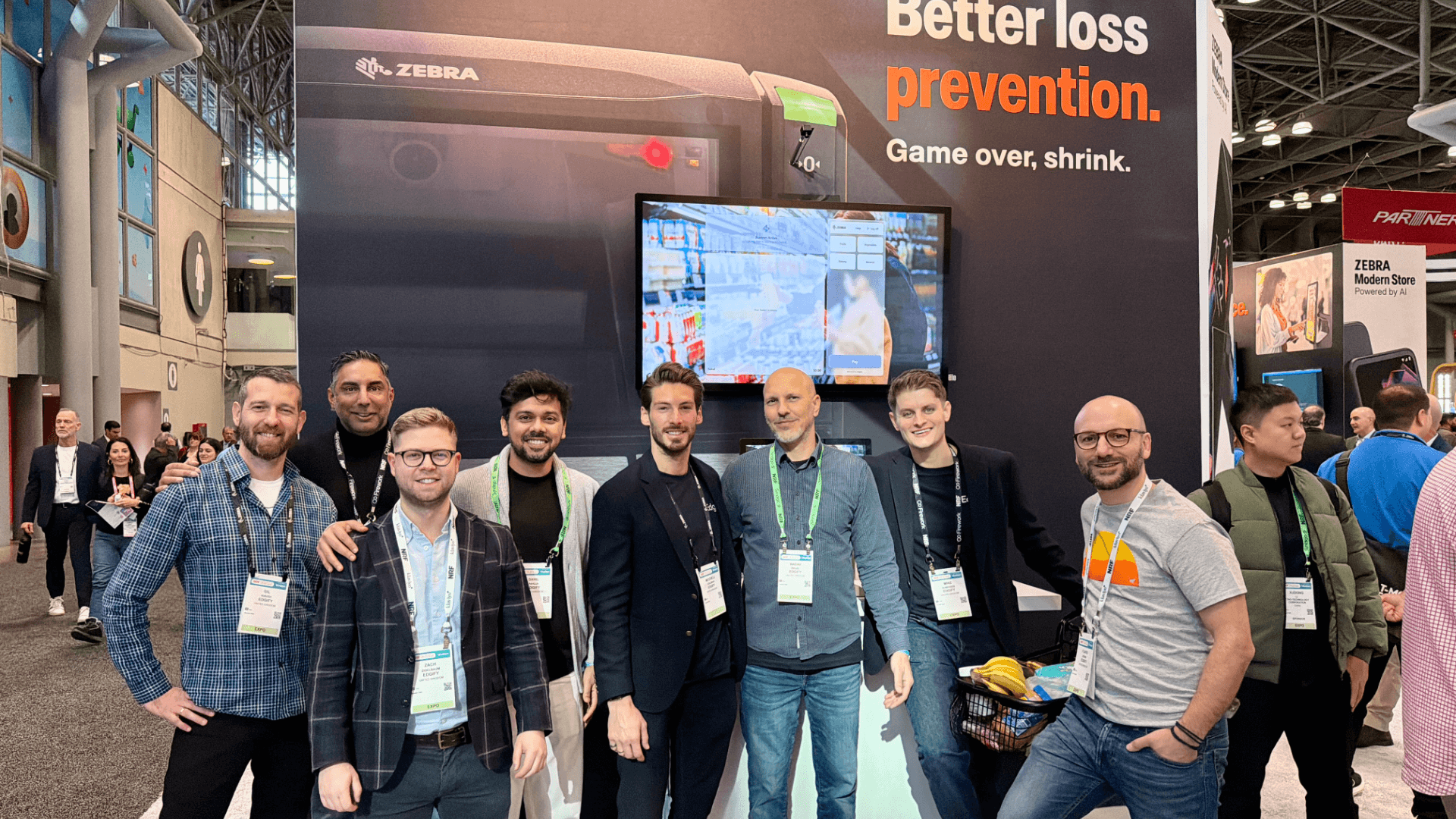
Edgify has just closed a $9 million Series A+ round led by Rank Ventures and Mangrove Capital Partners, bringing total funding to $25 million. But the real news isn’t the money: it’s the architectural model the Israeli startup is pushing—a bet on distributed intelligence that could reshape the relationship between devices, data, and the cloud.
Edgify’s platform turns existing hardware—self-checkouts, cameras, scales, POS systems—into nodes of a collective learning network. Instead of streaming video and transaction data to a remote server, computer vision models run locally, sharing insights and updates without ever moving raw data. This goes beyond simple inference: devices perform continuous on-the-fly fine-tuning from their unique vantage points, orchestrated by a framework that remains hardware-agnostic (Zebra Technologies and Bizerba are partners).
In grocery retail, this architecture has already proven its teeth in loss prevention. The system detects behaviors like scan avoidance, barcode switching, or items left in the cart, and intervenes in real time—shrinking inventory discrepancies without burdening bandwidth or cloud costs. Crucially, customer data stays within the store, a significant advantage in privacy-conscious markets like Europe.
Beyond the checkout lane
The expansion announced today takes the same logic to convenience stores, quick-service restaurants, distribution centers, and apparel. But the broader ambition touches transportation, warehouse logistics, and manufacturing floors—anywhere fleets of devices face similar constraints: legacy hardware, connectivity costs, and latency. The pitch of turning existing equipment into a coordinated intelligence layer, without requiring a dedicated data center, speaks directly to plant managers evaluating the TCO of modernization.
Market tailwinds back the move. Edgify cites projections that the global Edge AI market will grow from $36 billion to roughly $386 billion by 2034, with retail computer vision alone representing a $15.8 billion segment. No wonder the funding isn’t confined to retail: the platform sold to supermarkets is the same one that can run a warehouse or an assembly line.
Winners, losers, and what it means for on-prem
Edgify’s move signals something structural. So far, edge computing has often been framed as a way to run pre-trained models near the data source. The differentiator here is federated learning in production: devices collaborate to improve a shared model without centralizing data. This shifts value creation from cloud to edge. Cloud infrastructure providers face erosion of the data streams that feed their compute and storage services; in contrast, hardware manufacturers and system integrators gain incentive to make their equipment compatible with smart software layers. End users, especially in regulated industries, gain sovereignty and lower operational costs but take on the complexity of managing a fleet of learning-capable devices.
For those considering on-premise deployment, the Edgify case offers a clear lesson: the choice is no longer just between a local server and the cloud. Today you can build a mesh of devices that learns without ever leaving the corporate perimeter, complying with GDPR and optimizing latency. The real challenge, however, lies in the maturity of orchestration tools and the ability to troubleshoot a system where learning is continuous and distributed. It’s an area AI-RADAR tracks closely, analyzing frameworks and architectures for those seeking solutions far from anyone else’s data center.
The Edgify funding isn’t a simple vertical extension; it’s a signal that AI is finding a home where data is truly born, and the line between dumb device and intelligent node is thinning. At least until the cloud stays outside the door.







💬 Comments (0)
🔒 Log in or register to comment on articles.
No comments yet. Be the first to comment!