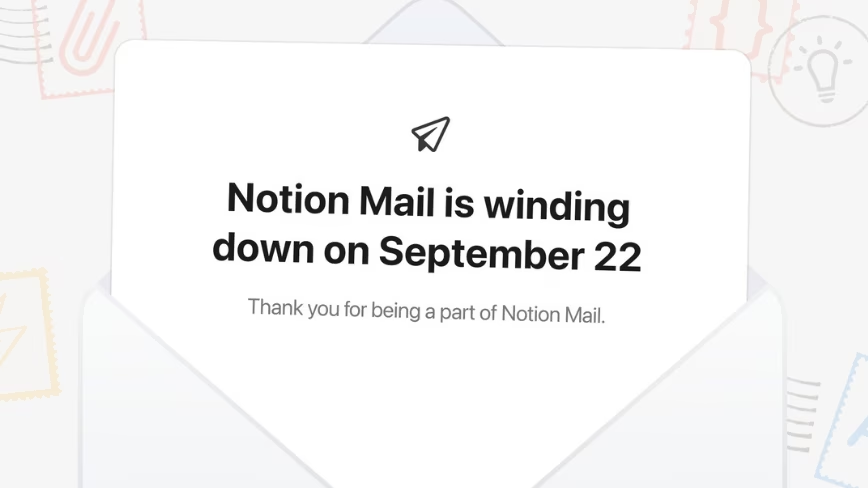
Notion has announced it will shut down its email client, Notion Mail, on September 22. The product — launched less than eighteen months ago as an extension of its all-in-one workspace — will cease to exist, and the explanation marks a turning point: AI agents are taking over tasks that previously required a traditional email interface. Triage, replies, scheduling — according to Notion, these are now handled without the user ever needing to open an inbox.
The news, reported by The Next Web, is a concrete signal of how the relationship between people and digital communications is being redrawn. It’s not just a feature removed from a productivity suite: it indicates that email control is shifting from direct user action to delegation to language models and automated workflows.
When the AI agent becomes the real recipient
For years we’ve talked about “inbox zero” as a personal efficiency goal, achievable with rules, filters, and discipline. Today the approach flips: you don’t empty your inbox, you let an AI agent handle it. Notion’s decision assumes that a significant share of users no longer want to interact with the classic email interface but prefer that relevant information emerges in a synthesized feed or automatic actions within other tools — like a collaborative workspace.
For those developing and distributing enterprise solutions, this trend raises delicate questions. If AI reads and writes email on our behalf, where is the data processed? Which models are used? Without details about the backend, the concrete risk is that sensitive messages — legal communications, contracts, strategic discussions — transit through third-party APIs, creating compliance issues ranging from GDPR to industry-specific regulations.
Data control and on-premise scenarios
The idea of an AI agent managing email isn’t new, but the fact that an established vendor like Notion shuts down its client because “agents take care of it” is a clear indicator of market maturity. For organizations that must guarantee data residency and sovereignty, the all-cloud model becomes unsustainable when email processing relies on external LLMs.
Deploying AI email agents on-premise — using open-source LLMs and local inference on dedicated hardware — keeps all communications within the corporate perimeter, reducing the exposure surface. It’s not a trivial choice: it requires integration with existing mail systems, real-time latency management, and infrastructure that scales with mailbox volume. Those evaluating self-hosted solutions for similar workloads must face the trade-off between TCO of an on-premise GPU cluster and the variable costs of cloud services, bearing in mind that privacy is non-negotiable in regulated sectors.
The shutdown of Notion Mail isn’t just a product page turned. It’s a symptom of an evolution that raises the bar for collaborative tool design: from inbox to AI agent, from data access to automated processing. The question remains: who will control that agent, and on what infrastructure will it run?




💬 Comments (0)
🔒 Log in or register to comment on articles.
No comments yet. Be the first to comment!