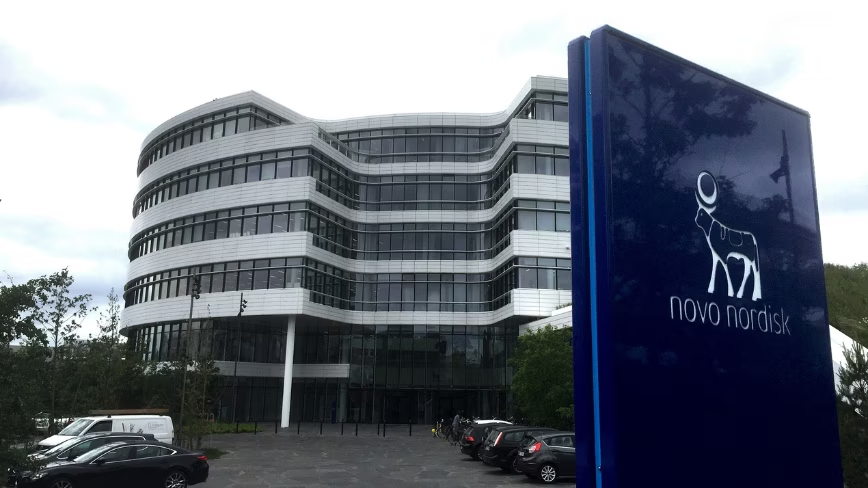
Novo Holdings, the investment company controlling pharmaceutical giant Novo Nordisk and managing the wealth of the Novo Nordisk Foundation, has decided to back a fund dedicated to Italian drug startups, according to Bloomberg. The move is not isolated: it follows a tried-and-tested strategy of allocating capital to life sciences hubs far beyond Denmark's borders, including European vehicles focused on deep-tech.
This geographical expansion responds to precise rationales. Denmark, while an epicenter thanks to Novo Nordisk, does not exhaust innovation potential. Italy, with a solid academic research ecosystem and competitive operating costs, becomes an attractive hunting ground for those seeking talent and pharmaceutical patents. It is no outlier: large sovereign funds and corporate venture capital are increasing their presence in hubs once considered minor, in search of asymmetric returns.
But there is an aspect beyond mere financial geography. The pharmaceutical industry is one of the most active in adopting artificial intelligence, particularly for drug discovery, molecular design, and clinical data analysis. This is precisely where infrastructure choices become critical: the handling of sensitive information, often covered by intellectual property constraints and privacy regulations like GDPR. When a startup or laboratory develops AI models on chemical or genomic data, controlling the data flow becomes strategic.
It is in this context that on-premise architectures for inference and training of Large Language Models (LLMs) gain relevance. It's not just about latency or TCO: hosting models in one's own data centers or on dedicated hardware keeps research data within a trusted perimeter, reducing exposure to third parties. For funded startups, relying on external cloud APIs can represent a regulatory bottleneck or a loss of competitive advantage tied to trade secrecy.
Of course, Novo Holdings' investment in an Italian fund does not automatically mean a surge in on-premise deployment. But it signals a direction where the convergence of pharmaceutical finance and AI is tightening. For those in the technical teams of these ventures evaluating the trade-off between cloud convenience and on-premise control, analytical frameworks now exist to map real costs, compute requirements for quantized models, and the impact on data sovereignty. This is not an abstract exercise: from choosing a beefed-up consumer GPU for inference to setting up a cluster with enterprise GPUs, the variables multiply.
The Italian landscape, moreover, has some cards to play: relatively low electricity costs, industrial districts with mechatronic know-how, and recent attention from the national recovery plan toward high-performance computing. In this picture, a fund backed by Novo Holdings could act as a catalyst for projects combining pharmaceutical research and AI infrastructure. It remains to be seen whether the bet will translate into startups capable of scaling, but the movement is clear: pharma innovation is no longer a matter of isolated labs, but of financial networks that embrace hardware, data, and algorithms. For those working at the intersection of these worlds, the message is unmistakable: architecture matters as much as the molecule.









💬 Comments (0)
🔒 Log in or register to comment on articles.
No comments yet. Be the first to comment!