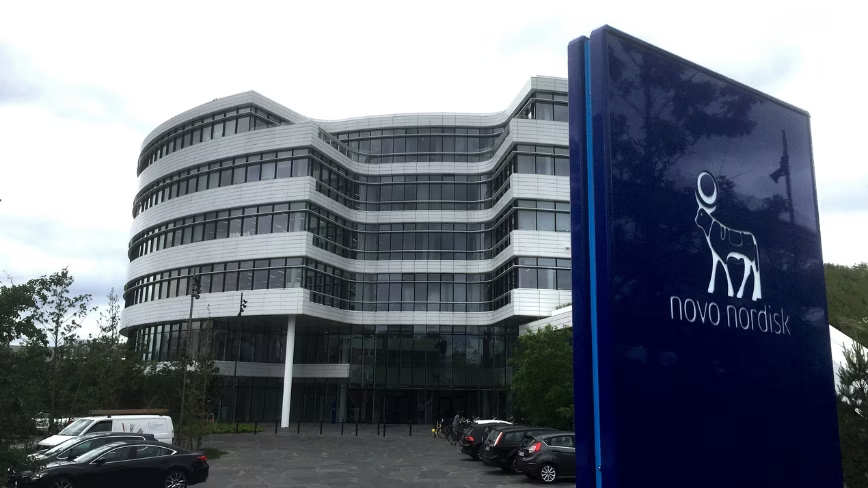
Novo Nordisk Hit by Ransomware Attack: FulcrumSec Claims Data Theft and $25M Ransom
The cyber-extortion group FulcrumSec recently announced it had stolen approximately 1.3 terabytes of sensitive data from Novo Nordisk, the renowned Danish pharmaceutical company known for producing weight-loss drugs like Wegovy and Ozempic. The announcement, made on Monday, also revealed a ransom demand of $25 million, aimed at preventing the disclosure of the stolen information.
Novo Nordisk, however, has confirmed that it did not yield to the criminal group's demands. This incident raises crucial questions about corporate data security and the resilience of IT infrastructures in the face of increasingly sophisticated threats. For organizations managing high volumes of proprietary and sensitive information, protection becomes an absolute priority.
Implications for Data Sovereignty and Infrastructure
The attack on Novo Nordisk highlights the escalating stakes in the cybersecurity landscape, especially for companies operating in regulated sectors such as pharmaceuticals. The theft of 1.3 terabytes of data represents a significant breach, with potential repercussions for patient privacy, intellectual property, and corporate reputation.
Novo Nordisk's decision not to pay the ransom, while ethically sound, implies that the FulcrumSec group might proceed with data disclosure. This scenario underscores the importance of robust data sovereignty strategies, which include not only attack prevention but also effective response and mitigation plans. For companies evaluating the deployment of AI workloads, including Large Language Models (LLM), the choice between self-hosted infrastructures and cloud solutions must consider these risks.
The Challenge of Security in AI Workload Deployment
Data security management is a critical factor for any organization, but it gains particular relevance when dealing with AI and LLM workloads. These systems often require processing vast datasets, which may include proprietary or personal information. An on-premise infrastructure, while demanding significant initial investment and internal management, can offer greater control over the physical and logical security of data, reducing the attack surface exposed to third parties.
Conversely, adopting cloud services can delegate some security responsibility to the provider but also introduces new dependencies and potential attack vectors related to API access and management. The evaluation of the Total Cost of Ownership (TCO) for security must consider not only the direct costs of solutions but also the indirect costs of a potential breach, such as non-compliance fines (e.g., GDPR), reputational damage, and operational disruption.
Mitigation Strategies and Infrastructure Choices
In the face of threats like those experienced by Novo Nordisk, companies must adopt a holistic approach to security. This includes implementing intrusion detection systems, encrypting data at rest and in transit, network segmentation, and continuous staff training. For those evaluating on-premise LLM deployment, AI-RADAR offers analytical frameworks on /llm-onpremise to assess the trade-offs between control, security, and operational costs.
The choice between a self-hosted infrastructure and a cloud environment is not trivial and depends on specific compliance needs, data sensitivity, and internal capacity to manage complex systems. While the cloud can offer scalability and agility, an on-premise or air-gapped deployment can ensure a higher level of data sovereignty and protection against external attacks, especially for critical data that cannot be exposed to third-party risks. The lesson from Novo Nordisk serves as a warning to all companies: data security is not a cost, but an essential investment.








💬 Comments (0)
🔒 Log in or register to comment on articles.
No comments yet. Be the first to comment!