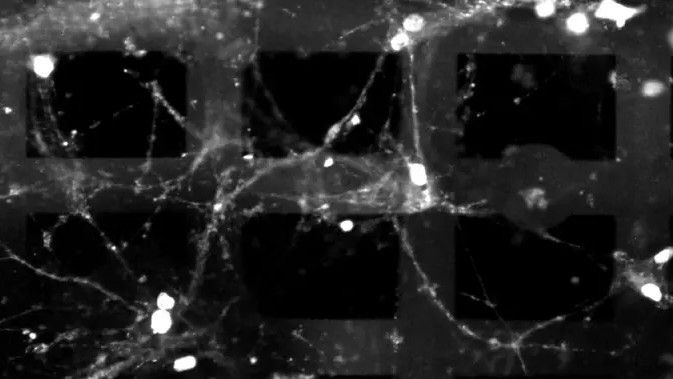
A New Computational Paradigm: The 3D Bioelectronic Device
Research in computer science constantly seeks new paradigms to overcome the limitations of current architectures. In this context, an innovative three-dimensional bioelectronic device emerges, promising to redefine the foundations of computation by directly integrating living tissue with electronics. This pioneering approach radically departs from traditional silicio-based processors, exploring the intrinsic potential of biological systems for information processing.
At the core of this innovation is the device's ability to compute using living brain cells. This is not a simulation, but a genuine integration where biological neurons become an integral part of the computational system. This fusion of biology and electronics opens up new scenarios for developing systems with learning and adaptation capabilities that could, in the future, surpass the performance of current models in specific domains.
Architecture and Function: Neurons on a 3D Electronic Mesh
The technological heart of this device is a three-dimensional electronic mesh, designed to provide a structured and interactive environment. Biological neurons are grown and developed on and through this mesh. This architecture allows for a direct and intimate interface between living tissue and electronic components, facilitating signal communication and processing.
The three-dimensional arrangement of the mesh is crucial, as it enables neurons to form complex connections and biological neural networks that can be electronically stimulated and monitored. The goal is to leverage the plasticity and energy efficiency of biological systems for complex computational tasks, such as pattern recognition or continuous learning, which currently demand significant resources from Large Language Models (LLMs) and traditional Inference infrastructures.
Implications for the Future of AI and Infrastructure
Although this technology is still in its early stages of development, its long-term implications for the artificial intelligence sector and computational infrastructure are significant. For CTOs, DevOps leads, and infrastructure architects, the search for alternatives to traditional silicio is a strategic priority, especially in an era where VRAM, throughput, and energy consumption requirements for LLM training and Inference continue to grow exponentially.
A device that utilizes living brain cells could, in a distant future, offer unparalleled energy efficiency and computational density. This could translate into a reduced TCO for specific AI workloads and greater flexibility for on-premise or air-gapped deployments, where data sovereignty and hardware control are paramount. However, challenges related to scalability, long-term stability, and interfacing with current digital systems remain considerable and will require years of research.
Future Prospects and Challenges
The path to transforming this research into a mature computational technology is still long and complex. Ethical issues, reproducibility, biological stability, and integration with existing software stacks represent significant hurdles. Nevertheless, the exploration of radically new computational architectures is fundamental for the advancement of AI.
For companies planning their long-term infrastructure strategies, monitoring these innovations is essential. Even if not directly applicable to current LLM deployments, bioelectronic research could one day offer solutions to problems that today seem insurmountable, pushing the boundaries of what is possible in terms of computational efficiency and capability. AI-RADAR will continue to follow these evolutions, providing analysis on the trade-offs and constraints that new technologies impose on decision-makers.





💬 Comments (0)
🔒 Log in or register to comment on articles.
No comments yet. Be the first to comment!