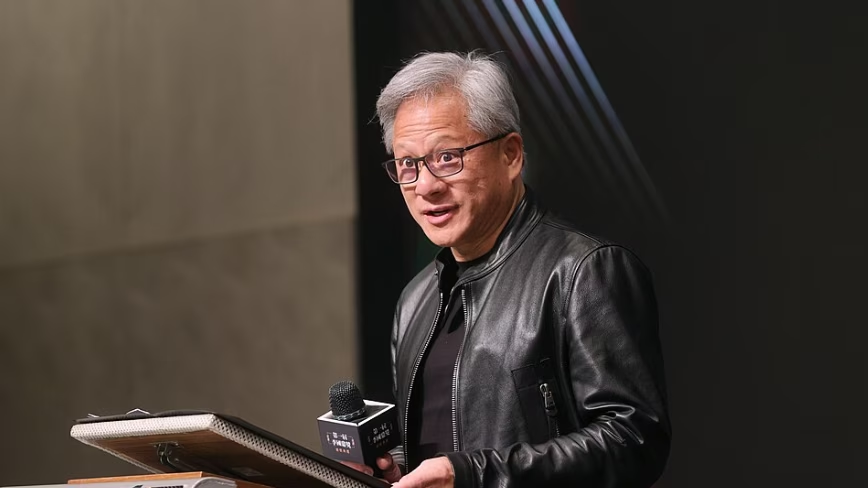
When Jensen Huang steps onto the stage at Nvidia’s shareholder meeting, his words carry the weight of molten silicon. The CEO’s latest public remarks, on the sidelines of the 2024 gathering, were no exception: “National security comes first.” A phrase that might sound like boilerplate, but one that acquires hard edges when dropped into the middle of the tech standoff between the United States and China, and the shadowy world of AI hardware smuggling. Huang didn’t mince words: anyone trying to build data centres by circumventing export controls is heading for a dead end.
The statement and the chip-smuggling spectre
Huang’s position emerged after a direct question about the friction between commercial opportunity and federal restrictions. Nvidia, which dominates the GPU market for LLM training and inference, has for years occupied the uncomfortable space of balancing a global order book against increasingly tight Washington rules. The explicit reference to smuggled data centres – entire racks of accelerators taking roundabout routes to customers in embargoed countries – sounds like a warning aimed both at regulators and at those operating in the shadows: the game is now about compliance, not evasion.
A control regime reshaping supply chains
Since 2022, the United States has steadily narrowed the exports of advanced chips to China, Russia and other high-risk actors. GPUs such as the A100 and H100 first, and the current H200 and B200, have been at the centre of these measures. The compute demands of modern LLMs – billions of parameters resident in VRAM, distributed fine-tuning, low-latency inference – make these units irreplaceable for anyone pursuing meaningful AI capacity. It is no surprise that a parallel market has sprung up: intermediaries buying hardware in third countries and reselling it through sophisticated triangulation schemes. Huang made it plain: that road leads nowhere.
What changes for on-prem AI infrastructure planning
For organisations evaluating a local LLM deployment – whether to guarantee data sovereignty or to contain long-term TCO – Huang’s statement is a powerful signal. On-premise setups, especially in sectors such as defence, healthcare or finance, depend on the guaranteed availability of certified hardware and transparent supply chains. Uncertainty around export licences, retroactive blocks and restrictions alters CapEx and OpEx calculations. Anyone planning a self-hosted architecture must now embed the geopolitical variable into their risk models: it’s no longer just a question of having GPUs powerful enough, but of being able to buy them without stumbling into bans or into “diverted” supplies that expose the buyer to sanctions.
The digital sovereignty knot and Europe’s position
Huang’s call also resonates in Europe, where GDPR and emerging regulations push towards local data centres and models trained within EU borders. Dependence on US hardware, subject to unilateral decisions from Washington, reignites the debate about technological sovereignty. While initiatives to design European chips multiply, those who today run on-prem training and inference pipelines must navigate between compliance requirements and the real availability of accelerators. The high road, according to Nvidia’s CEO, is to play by the rules, even if that means forgoing short-term market share. For industry insiders, this trade-off shifts the focus onto regulatory predictability as an infrastructural requirement, almost on a par with memory bandwidth or TFLOPS.






💬 Comments (0)
🔒 Log in or register to comment on articles.
No comments yet. Be the first to comment!