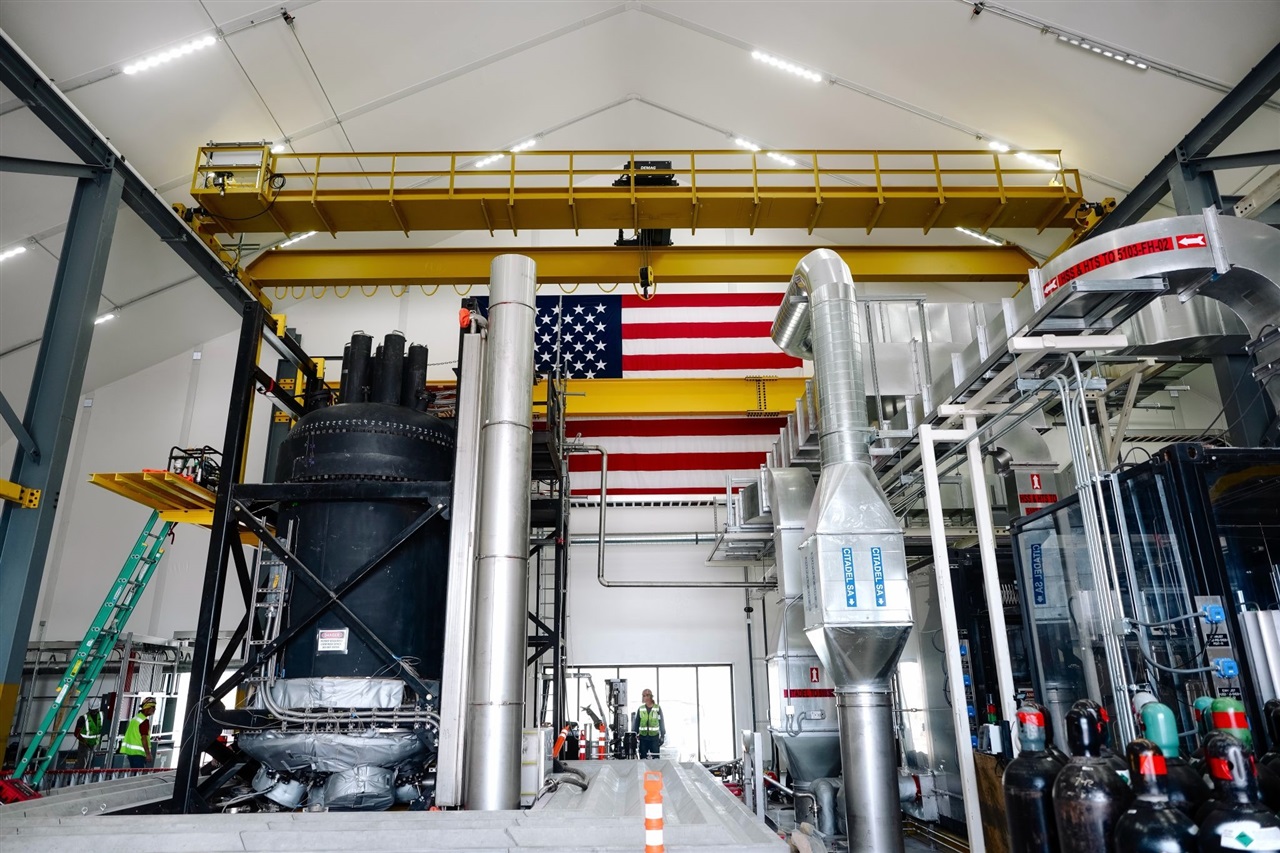
It’s no secret that training and inference of large language models are shifting the bottleneck from chips to energy. The news that Nvidia and startup Valar Atomics are testing a nuclear microreactor to power an AI data center brings the issue to the fore, with a solution that is both radical and predictable for those tracking infrastructure evolution.
The microreactor concept – a compact nuclear generation unit, typically under 20 MWe, designed for on-site installation and years-long operation without refueling – has been discussed for data center energy autonomy for some time. The difference now is the direct involvement of Nvidia, whose hardware dominates accelerated computing clusters, and a dedicated advanced fission startup like Valar Atomics. The combination signals that the energy game has moved to the operational phase, beyond theory.
Why a reactor next to the servers
An on-premise cluster of H100 or B200 GPUs can easily saturate the available power in many industrial areas, forcing those evaluating local deployments to revise TCO calculations to include grid connections, UPS systems, and increasingly, dedicated generation sources. A microreactor promises to eliminate these variables: it delivers constant, predictable, carbon-free power independent from the public grid. For AI workloads running 24/7, that prospect upends the traditional Capex vs Opex energy trade-off.
It is no coincidence that interest in small-scale nuclear is growing precisely in the data center sector. Inference of ever-larger models, often replicated across multiple nodes for redundancy and low latency, turns every watt into a critical capacity planning factor. Unlike intermittent renewables, a microreactor provides a near-100% capacity factor, making massive battery storage unnecessary and reducing the complexity of a truly autonomous on-premise architecture.
Nvidia’s role and future scenarios
Nvidia doesn’t make reactors, but its presence in the project suggests a joint test on real compute loads: likely a data center equipped with Hopper or Blackwell GPUs, where the reactor becomes the sole energy source. This type of validation is crucial to convince regulators and investors that a microreactor can sustain variable computational loads, with sudden spikes during distributed training phases.
On the data sovereignty front, the pairing of microreactor plus self-hosted AI cluster could reshape what’s feasible. Public organizations, research centers, and companies bound by strict data residency regulations could deploy computational capacity in otherwise inaccessible sites, without depending on inadequate power grids or on cloud providers whose data centers are concentrated in a few regions. Regulatory hurdles and social acceptance of small-scale nuclear remain unknowns, but the mere fact that field testing is beginning moves the conversation from paper to machine room.
For those currently evaluating an on-premise AI infrastructure investment, the message is clear: the energy paradigm is shifting faster than chip roadmaps. Microreactors aren’t yet a commodity, but every test like Nvidia and Valar’s shortens the path to a real offering where energy independence becomes the final piece of full control over the compute stack.








💬 Comments (0)
🔒 Log in or register to comment on articles.
No comments yet. Be the first to comment!