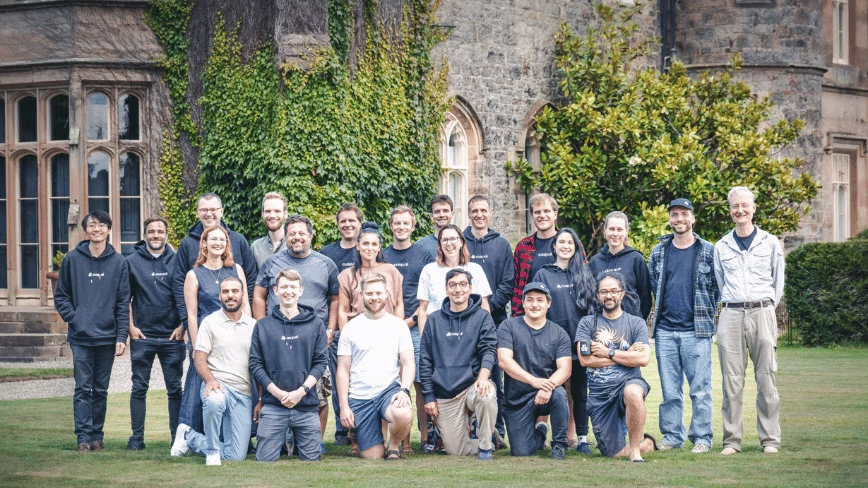
A two-year-old Cambridge lab named CuspAI gathered an unusual coalition on Monday to rewrite the rules of materials science. It launched the AI Materials Foundry, a partnership of over 45 companies and research institutes that counts Nvidia, Meta, Samsung, and Hyundai Motor among its founding members. The goal: to build a search engine for materials that don’t yet exist, using generative AI to explore chemical combinations beyond human imagination.
As reported by Reuters, the news runs deeper than the headline. What brings together a chipmaker, two electronics giants, and an automaker is not just scientific curiosity. It is the acknowledgment that the next battlefield for intellectual property will be fought on specialized hardware and protected data. And here, the choice of partners takes on strategic weight.
Nvidia is no mere supplier; its presence as a founder transforms the foundry into a proving ground for enterprise adoption of GPUs and on-premise computing. Designing materials through LLMs or diffusion models demands a level of compute that public cloud cannot always deliver with predictable latency and cost. Would you ship your proprietary battery-alloy data to a hyperscaler? Many of the companies involved clearly think not. That is why the AI Materials Foundry also serves as an accelerator for local and hybrid deployments, with Nvidia providing the technological bedrock.
For those tracking on-premise AI dynamics, the signal is unmistakable: advanced materials R&D is moving away from cloud-first toward controlled infrastructure, where data sovereignty is not an accessory but a competitive prerequisite. Meta, for its part, brings large-scale language model expertise; Samsung and Hyundai Motor add concrete industrial demand, closing the loop between research and production.
The project does not disclose numbers or technical specs, but it is reasonable to assume the coalition will spur adoption of multi-GPU interconnected systems, NVLink, and mixed-precision quantization to keep total inference costs down. The AI Materials Foundry could become the catalyst that convinces manufacturing enterprises to build their own private data centers instead of renting capacity, shifting the balance between capital and operational expenses.
Ultimately, the initiative marks an inflection point: it is no longer about proving that AI can speed up materials discovery, but about building the physical infrastructure to do so at industrial scale. A move that redraws the power lines between those who own chips, those who own data, and those who hold the patents—while the rest of the market watches and learns.









💬 Comments (0)
🔒 Log in or register to comment on articles.
No comments yet. Be the first to comment!