Nvidia's Strategic Investment in Hydra Host
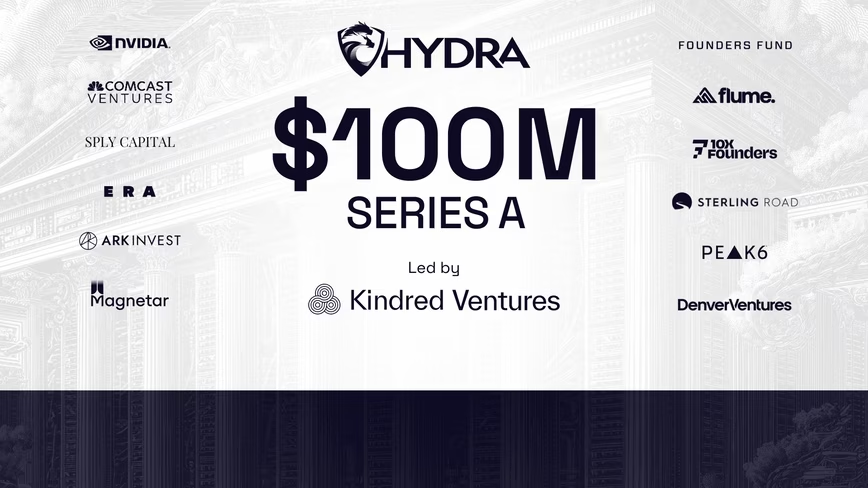
The artificial intelligence landscape is constantly evolving, and the underlying market dynamics are often complex and counterintuitive. A prime example is the announcement of a $100 million Series A funding round for Hydra Host, a startup aiming to build the foundational infrastructure – the so-called “plumbing of the AI boom” – for AI expansion. Kindred Ventures led the round, but attention has focused on one of the new investors: Nvidia.
Nvidia's participation in Hydra Host's funding is particularly noteworthy, considering the startup's stated goal: to turn GPUs, the chips on which much of Nvidia's success is built, into a commodity. This strategic positioning suggests a long-term vision from the silicon giant, which may aim to support the overall growth of the AI ecosystem, even at the cost of redefining the perceived value of its own hardware products. Other prominent investors include ARK Invest, Comcast Ventures, Magnetar, and PEAK6, underscoring widespread interest in innovative AI infrastructure solutions.
The Commoditization of GPUs and Its Implications
The idea of commoditizing GPUs implies greater accessibility and standardization of these computational resources. For companies operating with AI workloads, particularly those involving Large Language Models (LLM) or complex generative models, the availability of GPUs at more predictable costs and with greater ease of integration could represent a turning point. Currently, access to high-end GPUs, such as Nvidia's A100 or H100 series, can be a limiting factor due to both cost and availability.
An approach to commoditization could lower entry barriers for the development and deployment of AI solutions, fostering broader adoption. For CTOs, DevOps leads, and infrastructure architects, this could translate into greater flexibility in designing their technology stacks. The ability to access more standardized GPU resources, less tied to specific vendors, could stimulate innovation and competition in the AI hardware and services sector.
Impact on On-Premise Deployments and TCO
Hydra Host's initiative has direct implications for deployment strategies, especially for those evaluating on-premise or self-hosted solutions. If GPUs effectively become a commodity, the Total Cost of Ownership (TCO) for implementing local AI infrastructures could see a significant reduction. This is a crucial factor for companies prioritizing data sovereignty, regulatory compliance, or the need for air-gapped environments, where direct control over hardware is paramount.
Increased availability and potential cost reduction of GPUs could make on-premise deployments more competitive compared to cloud offerings, which often involve recurring operational costs and reliance on external providers. However, it's important to consider that managing an on-premise AI infrastructure requires specific expertise in cooling, power, networking, and orchestration—aspects Hydra Host aims to simplify through its “plumbing.” For those evaluating these alternatives, AI-RADAR offers analytical frameworks on /llm-onpremise to understand the trade-offs and specific requirements.
Future Prospects and Strategic Trade-offs
Nvidia's investment in Hydra Host highlights a complex strategy: on one hand, the company dominates the high-end GPU market; on the other, it supports an initiative that could democratize access to these very resources. This move could be interpreted as an attempt to further expand the overall AI market, ensuring that demand for GPUs continues to grow, even if the unit price were to decrease in the long term. Nvidia could benefit from a broader and more accessible AI ecosystem, where its chips, while becoming a commodity, remain the essential component.
For businesses, the prospect of GPUs as a commodity offers opportunities for cost optimization and greater control, but also requires careful evaluation of internal infrastructure management capabilities. The AI market is set to see further diversification of offerings, with an increasingly delicate balance between flexible cloud solutions and robust, controlled on-premise deployments. The challenge will be to balance cost efficiency with operational complexity and the need for scalability, always maintaining neutrality in the choice of technological solutions.




💬 Comments (0)
🔒 Log in or register to comment on articles.
No comments yet. Be the first to comment!