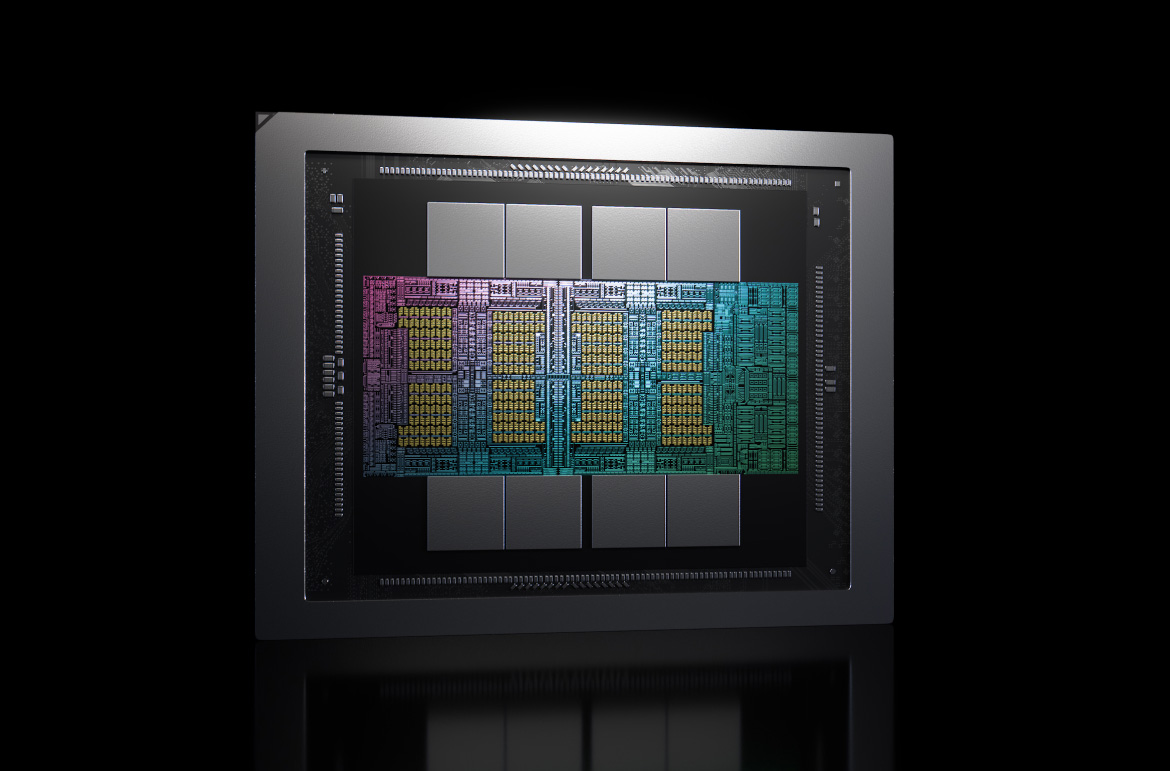
NVIDIA chose SC26 as the stage to announce an explicit return to high-performance computing. The Rubin HPC server GPU, expected in 2028, brings over 50,000 CUDA cores and a positioning aimed at scientific and engineering workloads. This is not simply an extension of the Rubin line built for AI data centers: the name and the stated target point to a product separation worth watching.
The first reading is technical. A high CUDA core count signals a large chip, but in HPC workloads the bottleneck is often elsewhere: floating-point precision, memory bandwidth, and the ability to move data between nodes. The source does not go into these details, and that absence matters: evaluating a scientific GPU requires looking beyond core count. Memory access patterns, data layouts, and the ability to sustain long simulations without degradation all count.
The second reading is about the ecosystem. HPC is a market historically tied to on-premise infrastructure. Research centers, universities, and industrial divisions tend to build and manage their own clusters for reasons of control, security, and cost predictability. In this context, NVIDIA's announcement carries a different weight than a cloud GPU: it enters multi-year procurement cycles, must fit local data center constraints around space, power, and cooling, and is also judged in terms of TCO. That is not a minor detail for organizations deciding whether to refresh a cluster or move some workloads outside.
NVIDIA's return to HPC comes at a time when the accelerator industry is dominated by demand for LLM training and inference. The decision to dedicate a specific variant to science and engineering signals that the design trade-offs for these two worlds are not the same. An accelerator built for neural network training may not be the optimal answer for a fluid dynamics simulation or a computational chemistry run. By separating the lines, NVIDIA seems to recognize that HPC is not a byproduct of AI, but a market with its own requirements.
For those watching local deployment, the message is clear: HPC platforms will keep receiving dedicated hardware, and the roadmap now extends to 2028. That reduces uncertainty for labs planning long-term investments, but it also introduces new complexity: maintaining skills for two ecosystems, managing different software stacks, and deciding whether workloads can coexist on the same infrastructure or need separate silos. The practical choice will depend on specific constraints, not on a generic comparison of specs.
AI-RADAR tracks exactly these trade-offs: for those evaluating on-premise deployments, there are analytical frameworks on /llm-onpremise that help lay out the real constraints of local infrastructure. With Rubin HPC, the variable to watch will be whether scientific software can take advantage of the new architecture: without a mature ecosystem of libraries and compilers, even the most capable silicon does not translate into useful results.
Rubin HPC's 2028 arrival leaves an open question: how much of the added power will go to traditional scientific workloads, and how much will be absorbed by hybrid pipelines that mix simulation and AI? The product separation is a signal, but the answer will only emerge when real workloads appear on the first clusters.






💬 Comments (0)
🔒 Log in or register to comment on articles.
No comments yet. Be the first to comment!