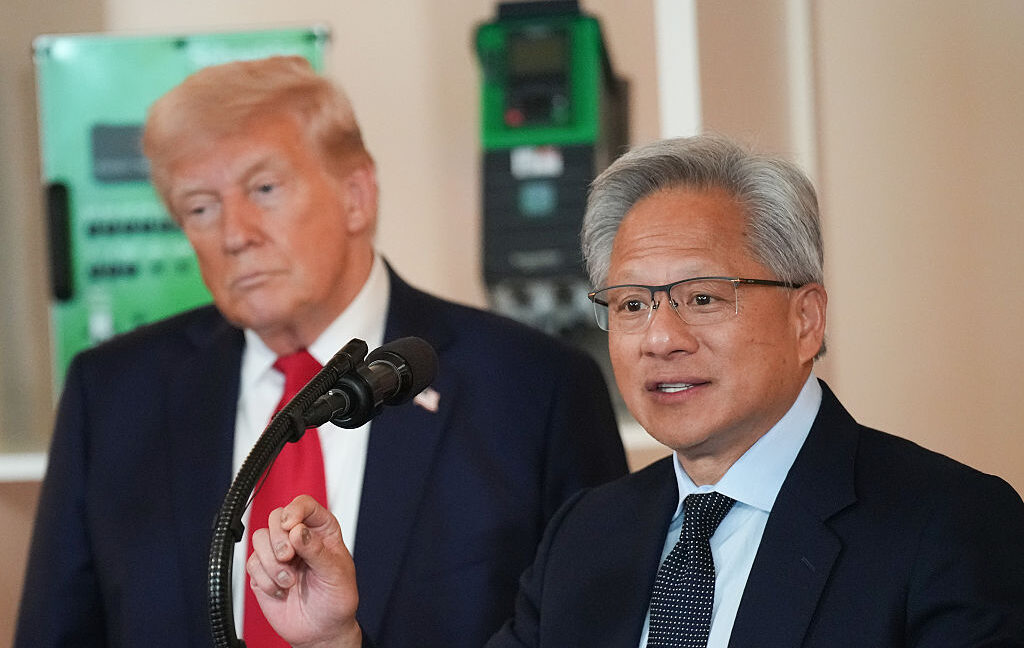
Nvidia Strengthens Presence in Taiwan with Massive Investment
Jensen Huang, CEO of Nvidia, has announced an annual investment plan of $150 billion destined for Taiwan. This strategic move aims to consolidate the island's position as the "epicenter of the AI revolution" and a global tech manufacturing hub for decades to come. The announcement, reported by Reuters, highlights the AI industry's critical reliance on Taiwan's production capacity and innovative ecosystem.
Huang emphasized Taiwan's irreplaceable role in the AI value chain, stating that it is where chips, packaging, systems, and AI supercomputers are created. The investment includes the construction of a new Nvidia headquarters in Taiwan, with the goal of making it operational by 2030, with groundbreaking expected this year. This initiative not only strengthens Nvidia's ties with its local partners but also projects Taiwan as a key player in shaping the future of artificial intelligence.
Taiwan's Strategic Role in the AI Supply Chain
Nvidia's decision to invest so heavily in Taiwan is not coincidental but reflects the island's deep integration into the global semiconductor and AI supply chain. Taiwan hosts manufacturing giants like TSMC, which are fundamental for producing the most advanced chips that power Large Language Models (LLM) and AI computing infrastructures. This concentration of expertise and production capabilities makes Taiwan a crucial node for any company dependent on high-performance hardware.
For organizations evaluating on-premise deployments of AI workloads, the stability and resilience of this supply chain are of paramount importance. The availability of GPUs with high amounts of VRAM and computing power is a decisive factor for the TCO and feasibility of self-hosted solutions. Nvidia's investment can help ensure a steady flow of essential components, but at the same time, it highlights the geographical concentration of critical resources, an aspect that data sovereignty and infrastructural resilience strategies must carefully consider.
Implications for On-Premise Deployments and Data Sovereignty
Nvidia's commitment to Taiwan has direct repercussions for companies choosing to implement AI solutions on-premise. The ability to acquire cutting-edge hardware, such as the GPUs required for LLM Inference and Fine-tuning, largely depends on Asian production. An investment of this magnitude can stabilize or even accelerate innovation and production, potentially improving availability and, in the long term, costs for self-hosted deployments.
However, the centralization of production in a single geographical region also raises questions regarding supply chain resilience and data sovereignty. Companies operating in regulated sectors or handling sensitive data often prefer air-gapped or self-hosted environments to maintain full control over infrastructure and data. Dependence on a concentrated supply chain requires strategic planning to mitigate potential disruptions, ensuring that the necessary hardware is available to support computing and compliance needs. For those evaluating on-premise deployments, AI-RADAR offers analytical frameworks on /llm-onpremise to assess trade-offs between costs, performance, and control.
Future Outlook and Control Over AI Infrastructure
Jensen Huang's vision for Taiwan as the "world's tech manufacturing hub for a long time" underscores a long-term trend. While some nations seek to localize chip production, the current reality is that the Taiwanese ecosystem remains unsurpassed in complexity and scale. This means that, for the foreseeable future, AI deployment decisions, especially those requiring cutting-edge hardware, will be intrinsically linked to the production capacity of this region.
For CTOs, DevOps leads, and infrastructure architects, understanding these dynamics is fundamental. The choice between a cloud infrastructure and a bare metal on-premise deployment is not just a matter of CapEx vs OpEx, but also of control over the underlying technology. Nvidia's investment reinforces Taiwan's importance, making it even more crucial for companies to have a clear strategy for hardware procurement and supply chain management, ensuring that performance, security, and data sovereignty requirements are fully met.







💬 Comments (0)
🔒 Log in or register to comment on articles.
No comments yet. Be the first to comment!