
Nvidia: From GPU to Complete AI Ecosystem
Nvidia, the undisputed leader in GPUs for artificial intelligence, is evolving its strategy. The company is no longer content with merely supplying graphics accelerators but aims to offer a complete, integrated "AI stack." This transition reflects a broader trend in the AI market, where the complexity of workloads, particularly with Large Language Models (LLMs), demands increasingly cohesive hardware and software solutions.
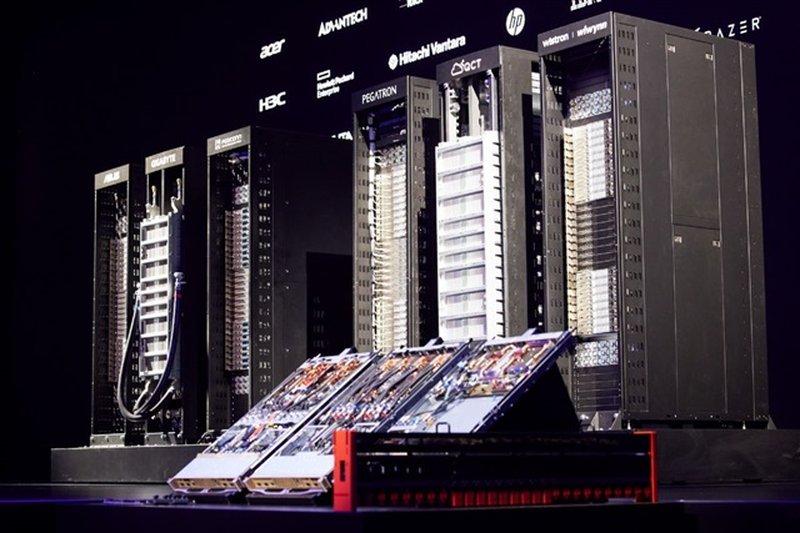
Nvidia's move, described as a "three-system push," suggests a holistic approach that goes beyond the single component. The objective is to simplify AI adoption and deployment for enterprises, reducing friction in integrating different parts of the technology stack. This is particularly relevant for organizations looking to implement AI capabilities in self-hosted or hybrid environments.
The Integrated Approach and the AI Stack
The concept of an "AI stack" refers to the complete set of hardware, software, and services required to develop, train, and deploy artificial intelligence models. Traditionally, companies assembled these components from various vendors. Nvidia's strategy aims to provide a more unified solution, which could include not only GPUs but also high-speed networking systems, software platforms optimized for inference and training, and management tools.
A "three-system" approach might indicate a segmentation of the offering into key areas such as high-performance computing, node interconnection, and the software layer for model orchestration and execution. This vertical integration is crucial for maximizing efficiency and throughput, fundamental elements for managing increasingly large and complex LLMs, which demand enormous amounts of VRAM and computational power.
Implications for On-Premise Deployment
For CTOs, DevOps leads, and infrastructure architects evaluating on-premise LLM deployment, Nvidia's strategy presents both opportunities and considerations. A vendor offering an integrated AI stack can potentially reduce the Total Cost of Ownership (TCO) by simplifying procurement, integration, and maintenance. This is particularly advantageous for companies with stringent data sovereignty, compliance requirements, or for air-gapped environments where reliance on cloud solutions is not feasible.
However, adopting a proprietary stack also involves trade-offs. While deep optimization and potential complexity reduction are gained, there might be increased vendor lock-in and less flexibility in choosing alternative components. The decision between a modular architecture and an integrated system depends on the organization's specific priorities, including performance requirements, budget, and long-term strategy. For those evaluating on-premise deployment, AI-RADAR offers analytical frameworks on /llm-onpremise to assess these trade-offs.
Future Prospects in the AI Market
Nvidia's move underscores the growing competition in the AI market, where value is shifting from individual components to the entire solution. Offering a complete stack allows Nvidia to extend its influence beyond hardware, positioning itself as a strategic partner for AI infrastructure. This approach could accelerate the adoption of LLMs and other AI applications in sectors requiring robust and scalable solutions.
In a rapidly evolving technological landscape, the ability to provide optimized and easy-to-deploy systems will be a distinguishing factor. Companies will continue to seek solutions that balance performance, cost, and control needs, making AI stack integration a priority for major industry players.







💬 Comments (0)
🔒 Log in or register to comment on articles.
No comments yet. Be the first to comment!