
Nvidia RTX Spark: A New Horizon for Windows on Arm and Gaming Compatibility
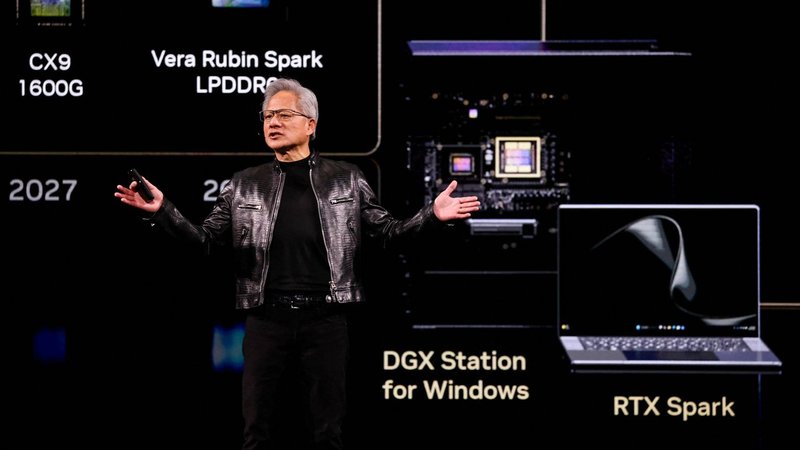
Nvidia recently announced the development of the RTX Spark chip, a new offering that promises to redefine the gaming experience and software integration within the Windows on Arm ecosystem. The presentation, which featured CEO Jensen Huang, highlighted the new silicon's ability to natively support all major anti-cheat and DRM (Digital Rights Management) technologies. This includes leading titles such as Fortnite, Valorant, and Denuvo solutions, ensuring smooth and uninterrupted operation on Arm-based platforms.
The introduction of RTX Spark by Nvidia is not just good news for gamers; it also represents a strategic step for the expansion of Windows on architectures other than x86. Native compatibility with anti-cheat and DRM systems has historically been a significant barrier to the adoption of new platforms in the gaming sector. Overcoming this challenge means paving the way for a more robust and versatile ecosystem, where developers can rely on hardware that manages software security complexities directly at the silicon level.
The Crucial Role of Native Compatibility on Arm
The Arm architecture has gained ground in various market segments, from mobile devices to servers, thanks to its energy efficiency and performance. However, integrating complex software, such as anti-cheat systems that operate at a very deep level of the operating system, has often required significant adaptation efforts or presented performance limitations when run via emulation. Nvidia's RTX Spark chip aims to solve these issues by offering hardware-accelerated support for these critical technologies.
This move underscores Nvidia's commitment to supporting the expansion of Windows on Arm, an environment that offers new opportunities for local and edge computing. For enterprises evaluating self-hosted solutions or deployments in air-gapped environments, the availability of powerful hardware natively compatible with a widespread operating system like Windows, even on different architectures, can significantly simplify development pipelines and application deployment. The ability to run complex workloads efficiently and securely on Arm hardware, with the backing of a player like Nvidia, is a factor to consider carefully.
Implications for the Ecosystem and Local Computing
While the initial announcement focuses on gaming, the implications of an Nvidia RTX chip with native support for Windows on Arm extend further. Nvidia is a key player in the hardware acceleration landscape for artificial intelligence, and the expansion of its offerings on Arm platforms could have significant repercussions for edge computing and AI workloads requiring local processing. The ability to manage complex and security-sensitive software natively on Arm could, in the future, facilitate the deployment of Large Language Models (LLM) or other AI models directly on local devices or servers with stringent energy efficiency requirements.
For CTOs, DevOps leads, and infrastructure architects, the emergence of new hardware platforms like RTX Spark, combining Nvidia's power with Arm's efficiency, opens up interesting scenarios. Evaluating the Total Cost of Ownership (TCO) for on-premise or hybrid solutions often includes considerations of hardware-software compatibility, security, and energy efficiency. A chip that resolves deep-level operating system compatibility issues can reduce operational costs and improve security, crucial elements for those prioritizing data sovereignty and infrastructure control.
Future Prospects and Nvidia's Role
Nvidia's initiative with RTX Spark highlights a broader trend in the tech industry: the pursuit of integrated hardware-software solutions that optimize performance and security across diverse architectures. Native support for critical technologies such as anti-cheat and DRM on Windows on Arm not only enhances the user experience but also sets a precedent for integrating advanced functionalities directly into the silicon. This approach is fundamental for the mass adoption of new platforms and for managing increasingly demanding workloads.
For those involved in AI infrastructure, the evolution of Nvidia's hardware offerings on Arm warrants attention. Although RTX Spark is gaming-oriented, the technology and experience gained in this area could be transferred to future solutions for on-premise or edge AI inference. AI-RADAR, in its focus on on-premise deployments and the trade-offs between control, data sovereignty, and TCO, closely monitors these hardware innovations, providing analysis to help decision-makers evaluate available options for their local stacks and AI pipelines.



💬 Comments (0)
🔒 Log in or register to comment on articles.
No comments yet. Be the first to comment!