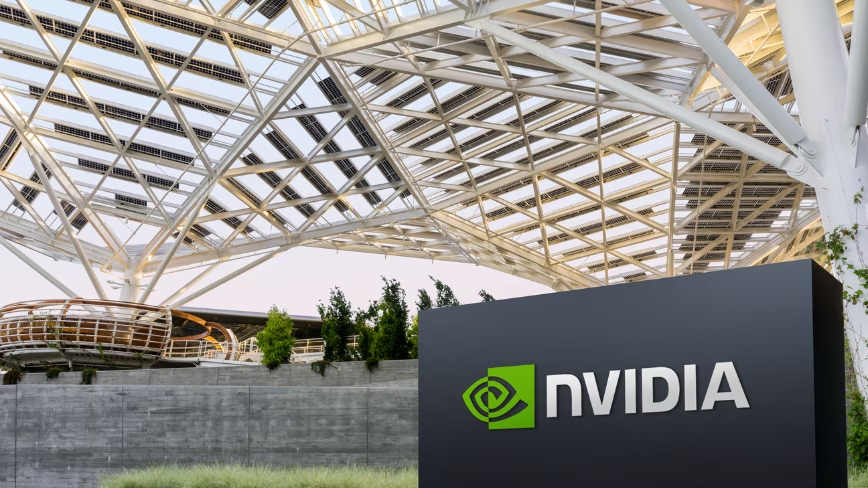
NVIDIA Dominates AI Market with Record Results
NVIDIA has reported exceptional financial results for the first quarter, solidifying its leadership position in the artificial intelligence sector. The company recorded revenues of $81.6 billion, a significant increase of 85% year-on-year and 20% quarter-on-quarter. These figures reflect robust demand for its hardware solutions, which are fundamental for the development and deployment of Large Language Models (LLM) and other AI applications.
The data center segment remains the primary driver of this growth, contributing $75.2 billion to the total quarterly revenues. This data underscores the critical importance of NVIDIA GPUs for infrastructures supporting intensive AI training and Inference workloads, in both cloud and self-hosted environments. The performance highlights the centrality of specialized silicon in the current technological landscape, where computing power is a decisive factor for innovation.
Financial Details and Capital Strategies
In addition to record revenues, NVIDIA announced a net income of $58.3 billion for the first quarter. The company also provided optimistic guidance for the second quarter, forecasting revenues to be around $91 billion. These figures not only exceed analyst expectations but also strengthen market confidence in the sustainability of NVIDIA's long-term growth.
As proof of this financial strength and confidence in its valuation, NVIDIA has increased its quarterly dividend from one cent to 25 cents per share. Concurrently, it has authorized an additional $80 billion share buyback program, the second such authorization in the last three quarters. These strategic moves aim to return value to shareholders and consolidate the company's capital structure during a period of strong expansion.
Implications for On-Premise AI Infrastructure
NVIDIA's financial results have direct repercussions for organizations evaluating the deployment of on-premise AI infrastructures. The strong demand for GPUs, highlighted by the data center segment's revenues, can influence the availability and TCO (Total Cost of Ownership) of self-hosted solutions. For CTOs, DevOps leads, and infrastructure architects, access to high-performance hardware like NVIDIA GPUs is a critical factor for the scalability and efficiency of their local LLM stacks.
NVIDIA's continuous growth suggests that pressure on the AI silicon supply chain may persist, making hardware procurement planning an essential component for those opting for an on-premise or air-gapped approach. The ability to acquire and manage adequate computational resources is fundamental for maintaining data sovereignty and ensuring compliance, aspects often prioritized over cloud-based consumption models. For those evaluating on-premise deployment, AI-RADAR offers analytical frameworks on /llm-onpremise to assess the trade-offs between costs, performance, and control.
Future Outlook and NVIDIA's Role in the Ecosystem
NVIDIA's success reflects the rapid evolution and pervasive adoption of artificial intelligence across all sectors. The company is not just a hardware provider but a key player enabling the entire AI ecosystem, from researchers developing new models to teams deploying them into production. Its financial performance is an indicator of the overall health of the AI market and the continuous need for specialized computing capabilities.
Looking ahead, the demand for LLM Inference and training solutions will continue to drive innovation and investment in hardware and infrastructure. Deployment decisions, whether for self-hosted, hybrid, or cloud environments, will be increasingly influenced by resource availability, TCO, and specific data sovereignty requirements. NVIDIA, with its dominant position, will continue to play a central role in these market dynamics.




💬 Comments (0)
🔒 Log in or register to comment on articles.
No comments yet. Be the first to comment!