Taiwan at the Heart of the AI Revolution: NVIDIA's Investments Reach $150 Billion Annually
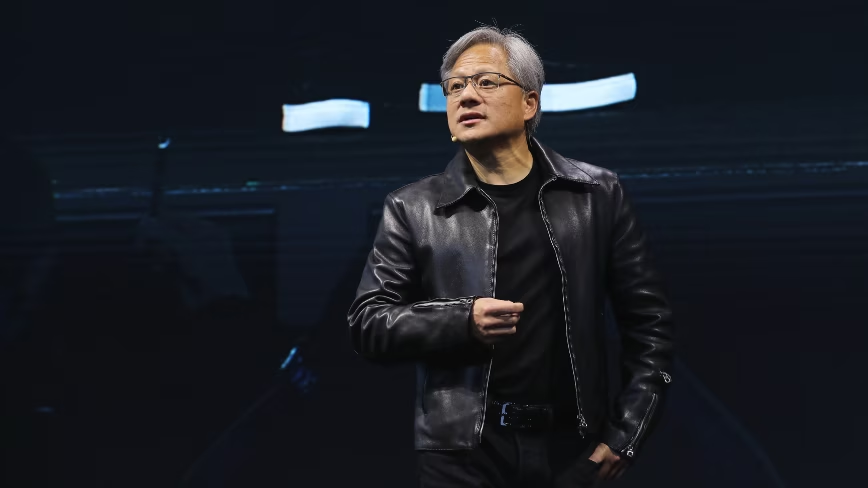
Jensen Huang, NVIDIA's CEO, recently highlighted Taiwan's crucial role in the global artificial intelligence landscape. During his participation at Computex 2026 in Taipei, Huang declared the island the "epicenter" of the AI revolution, announcing a significant financial commitment from his company. NVIDIA plans to allocate approximately $150 billion annually to Taiwan, a figure representing the highest specific investment on the island ever publicly disclosed by the CEO.
This announcement not only underscores Taiwan's centrality in NVIDIA's strategy but also raises important considerations for companies planning their Large Language Models (LLM) deployments and other AI infrastructures. The scale of this investment reflects the growing demand for computational capacity and the reliance on a robust supply chain to support the global expansion of artificial intelligence.
Taiwan's Strategic Role in the AI Supply Chain
Huang's statement is not coincidental. Taiwan has long been a fundamental pillar of the global semiconductor industry, hosting some of the leading silicon manufacturers and assemblers of critical components for AI hardware, particularly GPUs. The island's advanced production capacity is indispensable for meeting the increasing demand for high-performance chips, essential for training and inference of LLMs.
For organizations evaluating a self-hosted or on-premise approach for their AI workloads, the stability and capacity of the Taiwanese supply chain are decisive factors. Hardware availability, delivery times, and associated costs directly influence the Total Cost of Ownership (TCO) of a local AI infrastructure. An investment of this magnitude by a key player like NVIDIA can have significant repercussions on these dynamics, potentially stabilizing or altering the availability and pricing of components.
Implications for On-Premise Deployments and Data Sovereignty
NVIDIA's substantial investment in Taiwan reinforces global reliance on this region for AI hardware. For companies aiming to maintain data sovereignty and full control over their AI operations, on-premise deployments represent a strategic choice. However, the realization of such infrastructures heavily depends on the availability and reliability of the supply chain for key components. The ability to acquire GPUs with adequate specifications, such as high VRAM and throughput for complex LLM inference, is crucial.
Hardware procurement decisions must consider not only the initial cost but also the resilience of the supply chain and potential geopolitical risks. This scenario prompts companies to carefully evaluate the trade-offs between the flexibility and scalability offered by the cloud and the control and security guaranteed by a self-hosted infrastructure. The ability to manage AI workloads in air-gapped environments or with stringent compliance requirements is directly linked to the availability of locally controllable hardware.
Future Outlook and Infrastructural Resilience
NVIDIA's announcement highlights a broader trend: the increasing importance of physical hardware and global supply chains in the era of artificial intelligence. As the demand for AI computational capacity continues to grow exponentially, the ability to produce and distribute the necessary components becomes a critical factor. For CTOs and infrastructure architects, understanding these dynamics is fundamental for planning long-term deployment strategies.
Diversifying supply sources and building resilience in hardware pipelines will be key aspects to mitigate risks and ensure operational continuity. AI-RADAR, for instance, offers analytical frameworks on /llm-onpremise to help companies evaluate the specific trade-offs and constraints of on-premise deployments, providing neutral guidance for informed and strategic decisions in the evolving AI landscape.








💬 Comments (0)
🔒 Log in or register to comment on articles.
No comments yet. Be the first to comment!