Neuromorphic Efficiency Meets Sound Waves
Neuromorphic computing, inspired by the functioning of the human brain, has long held promise for overcoming the energy efficiency limitations of traditional AI chips. However, even the most advanced neuromorphic devices available today still exhibit limited complexity, far from the thousands of synaptic connections found in a single biological neuron. This gap restricts their ability to process information in a truly parallel and adaptive manner.
New research, published in Science Advances, suggests that integrating sound waves could unlock the true potential of this technology. The idea is to use acoustic properties to more faithfully emulate biological neurons, allowing neuromorphic devices to operate with greater speed and energy efficiency compared to their electronic counterparts. This approach could redefine AI hardware architectures, making them more suitable for scenarios where energy consumption and space are critical constraints, such as on-premise or edge deployments.
Acoustic Synapses and Parallel Computing
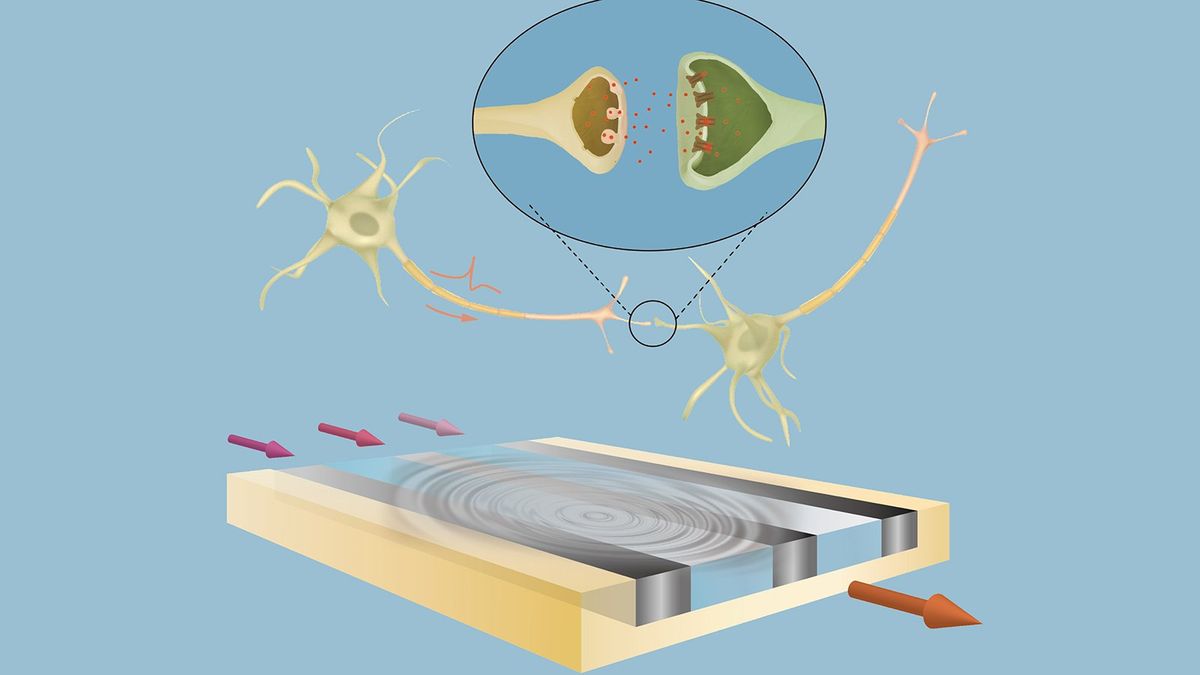
The core of this innovation lies in the development of acoustic synapses capable of hosting so-called "phi-bits" (phase bits). Unlike conventional bits, which represent only two states (0 or 1) and require a separate physical component, phi-bits can encode multiple values and coexist within the same space. While not strictly quantum computations, these phi-bits support "quantum-like" logic and parallel computing, paving the way for simultaneous data processing with significantly lower power requirements compared to traditional electronics.
The prototype developed by researchers, led by Professor Xiaodong Yan from the University of Arizona, consists of three aluminum rods, each approximately 60 centimeters long and 1.25 centimeters wide, connected by epoxy glue. Ultrasonic transmitters and sensors, attached with a thin layer of honey, allow for encoding and detecting data streams through acoustic interactions between the rods. This configuration enabled the modulation of phi-bit phases, mimicking biological synaptic plasticity – the ability of synapses to strengthen or weaken over time, which is fundamental for memory formation and retention. This property allowed the acoustic synapse to be trained to perform various tasks.
Performance and Implications for On-Premise AI
Experimental tests have demonstrated the effectiveness of this new architecture. In the task of classifying 150 flowers into three iris species, the acoustic device, simulating a single synapse, achieved a final accuracy of 96.7% using only 39 parameters. It also reached its peak accuracy 20% faster than a conventional chip-based neural network, such as a multilayer perceptron (MLP). To achieve comparable accuracy, an MLP would have required nine neurons and a greater number of parameters, highlighting the intrinsic efficiency of the new approach.
A crucial aspect for decision-makers evaluating the deployment of AI workloads, including Large Language Models (LLM), in on-premise environments is the Total Cost of Ownership (TCO). In this context, energy efficiency is a decisive factor. Researchers estimated that their new device consumes at most one-tenth the power required by state-of-the-art electronic neuromorphic hardware. This data is extremely relevant for reducing operational costs and the carbon footprint of AI infrastructures, making self-hosted solutions more competitive compared to cloud alternatives. For those evaluating on-premise deployments, AI-RADAR offers analytical frameworks on /llm-onpremise to assess trade-offs between performance, energy consumption, and costs.
Towards Adaptive and Flexible AI Systems
Beyond efficiency and speed, the research revealed another surprising capability of acoustic synapses: the ability to mimic the activity of neuromodulators, critical molecules like dopamine or serotonin that influence the sensitivity and learning strength of biological synapses. While replicating neuromodulation in conventional neuromorphic hardware requires complex designs, researchers found that with an acoustic synapse, simply adding an extra rod allowed the system to mimic several neuromodulatory processes, including rapid and slow responses.
This flexibility is fundamental for developing more adaptive AI systems, capable of using the same circuit to perform different functions depending on the context, rather than requiring separate neural networks for each task. As highlighted by Brad Aimone of the Center for Computing Research at Sandia National Laboratories, this could lead to smaller, more versatile neural networks capable of self-regulation. This prospect opens exciting scenarios for the AI of the future, promising more compact, efficient, and intelligent hardware, ideal for the data sovereignty and control needs typical of on-premise and air-gapped environments.



💬 Comments (0)
🔒 Log in or register to comment on articles.
No comments yet. Be the first to comment!