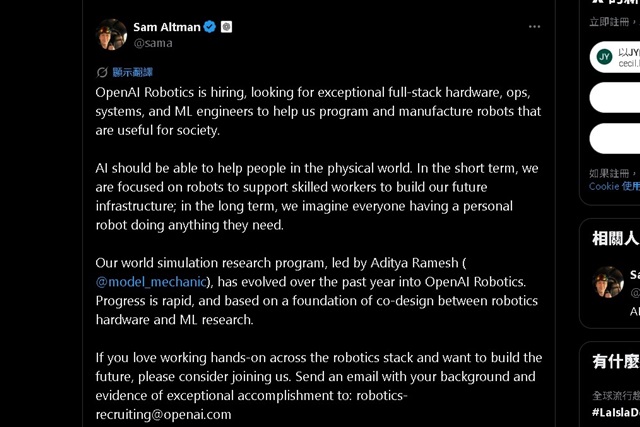
OpenAI Expands Robotics Ambitions, Recruiting for Hardware and AI Development
OpenAI, the pioneering company in Large Language Models (LLMs), is significantly expanding its ambitions in the robotics sector. The announcement, shared via a post by Sam Altman on the X platform, reveals a recruitment campaign targeting engineers specialized in both hardware development and artificial intelligence applied to robotic systems. This strategic move marks an evolution for the company, progressively shifting beyond the exclusive domain of language models to explore the physical applications of AI in the real world.
OpenAI's initiative highlights a growing trend in the tech industry: the convergence of advanced AI and robotics. While LLMs have demonstrated extraordinary capabilities in language understanding and generation, the next challenge for artificial intelligence lies in its ability to physically interact with the environment. The investment in talent for robotic hardware and software development suggests a long-term vision aimed at creating more intelligent and versatile autonomous systems.
Technical Requirements and Infrastructure Implications
The development of advanced robotics, particularly AI-driven robotics, imposes stringent technical requirements. Robotic systems need real-time processing capabilities to perceive the environment, make decisions, and act with precision and low latency. This often translates into the need for dedicated hardware, such as specialized GPUs or custom silicon, capable of performing complex inference operations directly on the device or in its proximity (edge computing). VRAM and throughput become critical factors for managing sensor data streams and executing complex AI models.
The integration of AI and robotics requires not only sophisticated algorithms but also a robust and optimized infrastructure. The development and deployment pipeline for these systems must consider aspects such as data collection and processing, model fine-tuning, and their release on heterogeneous hardware platforms. The choice between on-premise, edge, or cloud deployment becomes fundamental, directly influencing performance, security, and the overall Total Cost of Ownership (TCO).
Data Sovereignty and On-Premise Deployment
OpenAI's expansion into robotics raises important questions regarding data sovereignty and deployment strategies. Robots operating in sensitive environments, such as factories, hospitals, or critical infrastructure, generate and process data that may be subject to strict regulations concerning privacy and compliance (e.g., GDPR). In these scenarios, a self-hosted or air-gapped deployment, where data remains within corporate or national boundaries, often becomes a non-negotiable requirement.
The on-premise or edge approach for robotic AI offers advantages in terms of reduced latency, greater control over security, and regulatory compliance. Although it may involve a higher initial investment (CapEx) for hardware acquisition and infrastructure management, it can reduce long-term operational costs (OpEx) and ensure greater autonomy. For organizations evaluating such workloads, AI-RADAR offers analytical frameworks on /llm-onpremise to assess the trade-offs between different deployment options, considering factors such as scalability, resilience, and TCO.
Future Prospects of AI Robotics
OpenAI's more decisive entry into the field of robotics heralds a future where artificial intelligence will not be confined to screens but will actively interact with the physical world. This evolution paves the way for more autonomous robots, capable of learning, adapting, and performing complex tasks in unstructured environments. The combination of LLMs' reasoning capabilities with robots' motor and perceptual skills could lead to revolutionary innovations in sectors such as manufacturing, logistics, healthcare, and exploration.
However, this transition is not without its challenges. The complexity of hardware-software integration, the need to ensure the safety and reliability of robotic systems, and the ethical implications of machine autonomy represent significant obstacles. OpenAI's recruitment drive underscores the importance of a multidisciplinary approach to overcome these barriers and realize the transformative potential of AI-driven robotics.








💬 Comments (0)
🔒 Log in or register to comment on articles.
No comments yet. Be the first to comment!