Oracle Redefines Server Procurement Strategy
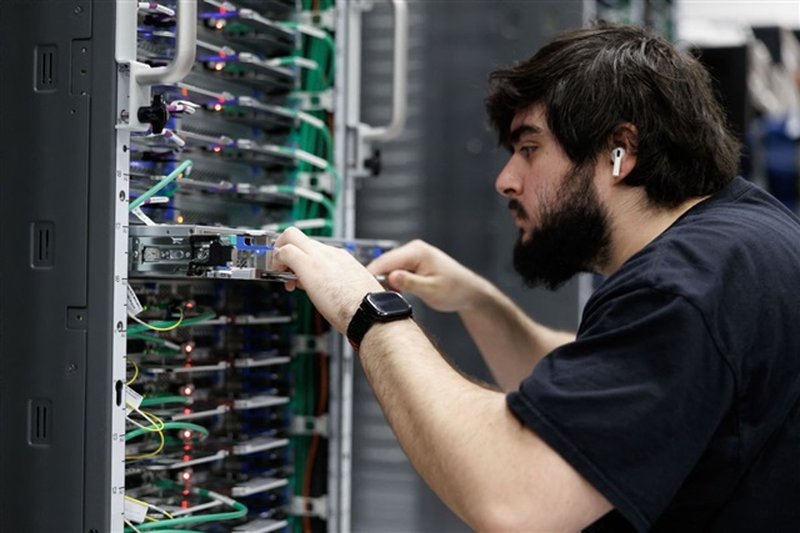
Oracle, a major player in the global technology landscape, has made a significant strategic move in its hardware procurement. The company has decided to shift its server orders, previously handled by Supermicro, to manufacturers based in Taiwan. While not accompanied by specific details on the motivations, this decision suggests a redefinition of supply chain priorities and a growing focus on diversifying suppliers.
The server sector, particularly that dedicated to artificial intelligence and Large Language Models (LLM) workloads, is characterized by rapidly growing demand and considerable logistical complexity. Oracle's choice to rely on Taiwanese manufacturers could be interpreted as an attempt to strengthen its supply chain, ensuring greater stability and, potentially, more direct access to critical components in an increasingly competitive market.
Taiwan's Central Role in Hardware Manufacturing
Taiwan has long been a critical hub for technological hardware production, from semiconductors to complete servers. Its dominant position is due to a mature industrial ecosystem, which includes chip manufacturing giants like TSMC and numerous server and component manufacturers. Oracle's decision to shift orders to the island further reinforces Taiwan's role as an epicenter of the global technology supply chain.
This change not only benefits local Taiwanese manufacturers, elevating their profile and business volume, but also highlights how large tech companies are reconsidering their procurement strategies in a constantly evolving geopolitical and economic context. The ability to ensure timely deliveries and access to cutting-edge technologies are decisive factors for those operating on a global scale, especially in capital-intensive sectors like AI.
Implications for On-Premise Deployments and TCO
For companies evaluating on-premise deployments of AI and LLM infrastructures, hardware supply chain stability is a critical factor. The availability of servers, GPUs (with specifications like VRAM and throughput), and other infrastructural components directly impacts the Total Cost of Ownership (TCO) and project deployment times. A disruption or delay in supply can have significant repercussions on operational costs and the ability to innovate.
Supplier diversification, such as that undertaken by Oracle, can be an effective strategy to mitigate risks and optimize long-term TCO. For those evaluating on-premise deployments, there are significant trade-offs that AI-RADAR explores in detail in its analytical frameworks on /llm-onpremise, offering tools to compare the costs and benefits of different architectures and procurement strategies. The ability to control one's own infrastructure, including in terms of data sovereignty and air-gapped environments, heavily depends on the robustness of the hardware supply chain.
Future Prospects and Strategic Choices in the AI Era
The AI server market is booming, driven by the need for computational power for the inference and training of increasingly complex LLMs. In this scenario, the strategic choices of companies like Oracle are not isolated but reflect a broader trend in the industry to optimize every aspect of their infrastructure. The pursuit of efficiency, resilience, and control over the supply chain will become increasingly crucial.
Hardware procurement decisions will directly impact companies' ability to scale their AI operations, whether for cloud services or self-hosted solutions. Understanding the dynamics of the global supply chain and the capabilities of different manufacturers is fundamental for CTOs, DevOps leads, and infrastructure architects who must make informed decisions for the future of their AI platforms.









💬 Comments (0)
🔒 Log in or register to comment on articles.
No comments yet. Be the first to comment!