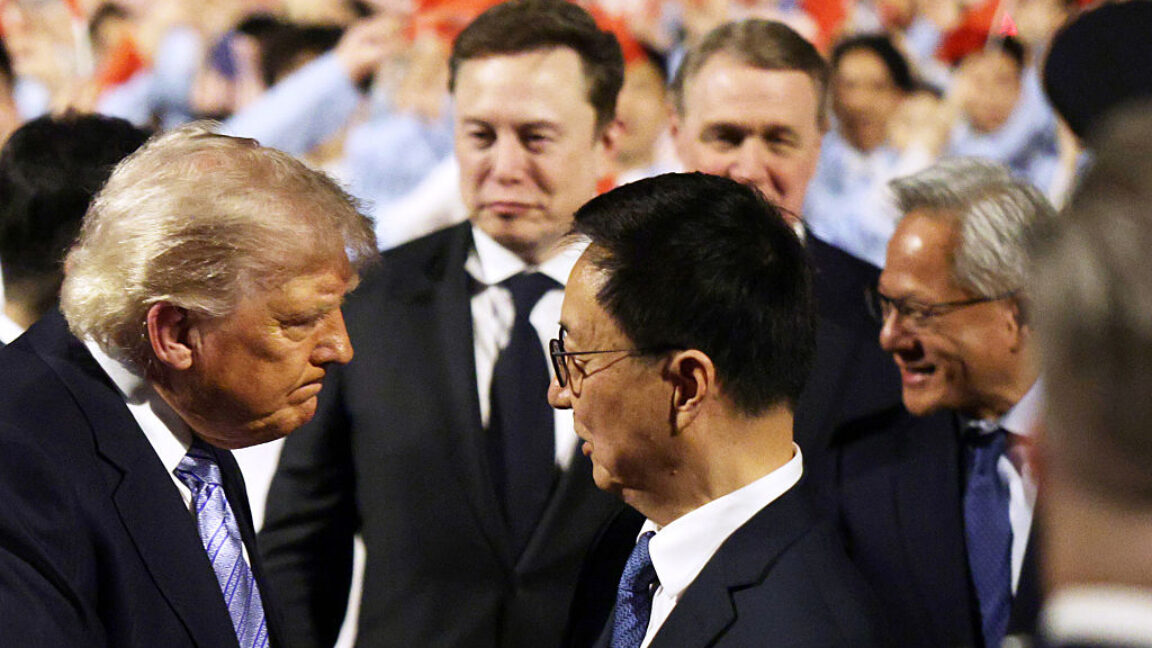
Trump's AI Executive Order Canceled: Tech CEOs Decline to Attend
President Donald Trump abruptly canceled a pivotal event scheduled for the signing of an executive order that would have granted the government the authority to test advanced artificial intelligence models before their public release. The decision, made just hours before the event, was prompted by the refusal of several leading AI firm CEOs to attend, despite only 24 hours' notice. This incident highlights the growing tensions between the political sphere and tech leaders regarding the governance and control of AI development.
According to reports from The New York Times, Trump had expected top executives from major AI companies to be present at the event. Their absence led to the cancellation, leaving some executives already en route to Washington with a wasted trip. The situation raises significant questions about the government's role in regulating rapidly evolving technology and companies' ability to maintain autonomy in developing and deploying their systems.
The Context of AI Governance and Frontier Models
The executive order aimed to establish a mechanism for governmental evaluation of "frontier AI models," referring to the most powerful and innovative Large Language Models (LLMs). The likely intent was to mitigate potential risks related to security, ethics, or social impact before such technologies became widely accessible. However, such an approach immediately raises complex issues for companies developing these models. The requirement to subject their systems to government testing before release could lead to significant delays, additional costs, and, crucially, the potential exposure of intellectual property and sensitive data.
For organizations considering on-premise LLM deployments, the prospect of pre-emptive government control adds another layer of complexity. Data sovereignty and control over the entire development and release pipeline are often key motivations for choosing self-hosted and air-gapped solutions. An external testing mandate could compromise these principles, influencing decisions regarding TCO and deployment strategy, pushing companies to further strengthen their local infrastructures to maintain maximum control.
Industry Reactions and Trade-offs
Reactions to Trump's initiative were varied. Semafor indicated that OpenAI "supported" the order's signing. In contrast, Elon Musk, founder of xAI, and Mark Zuckerberg, CEO of Meta, reportedly lobbied to "derail" the executive order, urging Trump to "call it off." David Sacks, a former Trump AI advisor whose government designation expired in March, also joined the push to delay the signing. This division reflects the broader industry debate on the balance between rapid innovation and the need for regulation.
For companies, the choice to collaborate with authorities or resist external intervention involves significant trade-offs. On one hand, collaboration could lead to higher security standards and trust, potentially benefiting the long-term adoption of AI. On the other hand, excessive government control could slow innovation, increase compliance costs, and create barriers to entry for new players. The issue of the 24-hour notice, deemed insufficient by the CEOs, also highlights a disconnect between political expectations and the operational realities of the tech sector.
Future Prospects and Implications for On-Premise
The cancellation of this executive order does not resolve the debate on AI regulation but postpones it. The episode underscores the complexity of defining an effective regulatory framework for a technology evolving at an unprecedented pace. For CTOs, DevOps leads, and infrastructure architects, this regulatory uncertainty reinforces the importance of deployment strategies that ensure flexibility, control, and data sovereignty.
In a landscape where government policies can change rapidly and profoundly impact operations, adopting local stacks and self-hosted solutions for LLMs becomes a strategic choice to mitigate risks. Maintaining on-premise inference and training in air-gapped environments allows companies to have full control over their models, data, and release processes, regardless of future external directives. AI-RADAR continues to explore analytical frameworks on /llm-onpremise to help organizations evaluate trade-offs and build resilient, compliant infrastructures.






💬 Comments (0)
🔒 Log in or register to comment on articles.
No comments yet. Be the first to comment!