Optical Innovation for Data Center Networks
For decades, the internal networks of data centers have relied on electrical switches. While established, this technology presents significant limitations in terms of power consumption and heat generation. These factors, combined with the increasing data processing demands of artificial intelligence systems, are transforming electrical switches into a bottleneck that slows down how quickly AI systems can process and exchange information.
In this context, Oriole Networks, a UK-based startup, has announced a potential solution. The company proposes replacing every electrical switch in the core network with optical components capable of operating at nanosecond scale. The stated goal is a drastic reduction, up to 81%, in network power consumption within data centers, an innovation that could redefine the efficiency of AI-dedicated infrastructures.
Technical Details and Current Challenges
Electrical switches inherently dissipate energy as heat, requiring complex and costly cooling systems. This vicious cycle further increases the overall TCO of a data center. With the explosion of Large Language Models (LLM) and the need to manage ever-larger data volumes with minimal latency, network throughput capacity has become a critical factor. Electrical switches struggle to keep pace, creating bottlenecks that prevent GPUs and other AI accelerators from operating at their maximum efficiency.
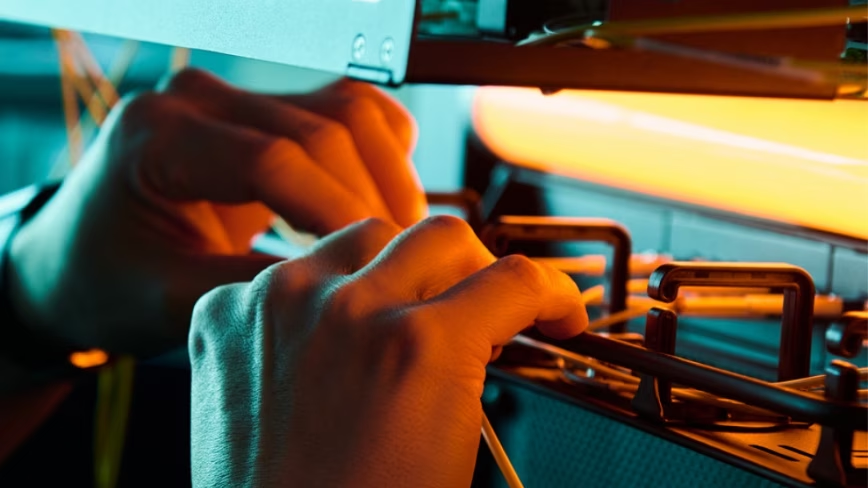
Oriole Networks' proposal focuses on adopting optical switches, which use light instead of electricity for data transfer. This technology promises not only a significant reduction in power consumption but also higher speed and lower latency, thanks to its nanosecond-scale operation. A shift to optical technology in the core network could therefore unlock new performance levels for the most demanding AI workloads, improving processing capabilities and data exchange between compute nodes.
Implications for On-Premise Deployments and TCO
For companies evaluating on-premise deployments of LLM and AI workloads, network efficiency is a fundamental aspect. The possibility of reducing network power consumption by 81%, as claimed by Oriole Networks, would have a direct and substantial impact on TCO. Lower consumption means lower energy bills and, potentially, reduced investment in cooling infrastructure. This is particularly relevant for self-hosted architectures, where every watt counts to keep operational costs under control and maximize return on investment.
In a context where data sovereignty and control over infrastructure are priorities, optimizing hardware and network resources becomes crucial. A more efficient and less energy-intensive network infrastructure allows for more resources to be allocated to actual compute for LLM inference and training, without having to excessively expand the data center's energy or physical footprint. For those evaluating on-premise deployments, AI-RADAR offers analytical frameworks on /llm-onpremise to assess the trade-offs between performance, costs, and control.
Future Prospects and Trade-offs
The introduction of radical technologies like optical switches into the heart of data centers represents a significant step towards more sustainable and high-performing infrastructures. If Oriole Networks' promises materialize, we could witness a paradigm shift in AI network design. However, adopting new technologies always involves an evaluation and integration phase, with potential trade-offs in terms of initial implementation costs and management complexity.
The search for solutions that improve energy efficiency and processing speed is relentless in the artificial intelligence sector. Oriole Networks' approach highlights how innovation is not limited to algorithms or compute hardware but also extends to critical infrastructure components, such as the network. This continuous development is essential to support the exponential growth of AI workloads and to make deployments, especially on-premise ones, increasingly competitive and sustainable.








💬 Comments (0)
🔒 Log in or register to comment on articles.
No comments yet. Be the first to comment!