The Ethical Appeal of "Magnifica Humanitas"
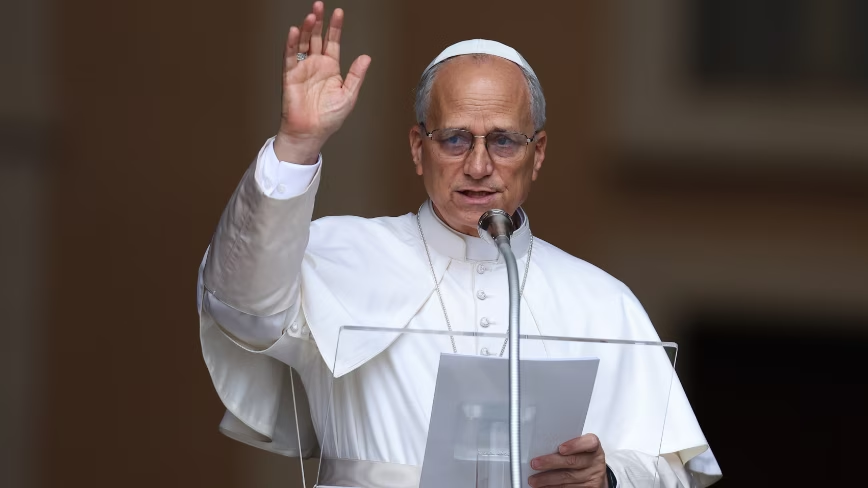
Pope Leo XIV has marked the beginning of his pontificate with the publication of his first encyclical, titled "Magnifica Humanitas." The document, comprising 245 paragraphs, was released in Rome and represents a significant call for the disarmament of artificial intelligence. The encyclical's presentation included the participation of Chris Olah, co-founder of Anthropic, underscoring the importance of dialogue between ethics and technology.
At the core of "Magnifica Humanitas" is a clear condemnation of algorithmic warfare and an explicit request to dismantle monopolistic control over AI technology. This stance highlights a growing concern for the ethical and social implications of AI, prompting deep reflection on its global development and deployment.
Implications for Technological Control and Data Sovereignty
The call to break up monopolistic control over AI resonates deeply within today's technological discourse, particularly for organizations evaluating the deployment of Large Language Models (LLM) and other AI solutions. Reliance on a limited number of cloud service providers can entail significant risks in terms of data sovereignty, regulatory compliance, and long-term costs. The encyclical, while not delving into technical specifics, reinforces the argument for more distributed and controlled architectures.
For businesses, the choice between cloud deployment and self-hosted or on-premise solutions is not merely a matter of performance or scalability, but also of strategic control. An on-premise approach, for instance, allows data to remain within an organization's infrastructural boundaries, ensuring greater security and adherence to regulations like GDPR. This can translate into a more predictable Total Cost of Ownership (TCO) and greater decision-making autonomy regarding the evolution of their AI pipeline. For those evaluating on-premise deployment, AI-RADAR offers analytical frameworks on /llm-onpremise to explore the trade-offs between cost, control, and performance.
Ethics and Responsibility in AI Deployment
Pope Leo XIV's condemnation of algorithmic warfare raises crucial questions about ethical responsibility in the development and deployment of AI systems. The automation of critical decisions, especially in sensitive contexts, requires careful evaluation of potential impacts. Algorithm transparency, auditing capabilities, and human intervention in the decision-making cycle become indispensable elements for ethical and secure AI.
Organizations that develop and deploy AI solutions are called upon to consider not only efficiency and innovation but also the moral implications of their technologies. This includes designing frameworks that prevent misuse and ensure that LLM inference and other operations are aligned with fundamental ethical principles, avoiding scenarios of conflict or algorithmic discrimination.
Future Perspectives for the Tech Community
The "Magnifica Humanitas" encyclical offers the technology community an opportunity to reflect on its role in building a responsible digital future. The call to disarm AI is not necessarily an invitation to halt progress, but rather to orient it towards goals that promote human well-being and cooperation, rather than destructive competition or centralized control.
CTOs, DevOps leads, and infrastructure architects face the challenge of balancing innovation with responsibility. Decisions regarding hardware, frameworks, and deployment strategies are no longer solely technical but are taking on an increasingly relevant ethical dimension. The discussion initiated by the Pope underscores the urgency of integrating ethical considerations from the earliest stages of design and development for any artificial intelligence solution.







💬 Comments (0)
🔒 Log in or register to comment on articles.
No comments yet. Be the first to comment!