
Pegatron and the Expanding AI Server Market
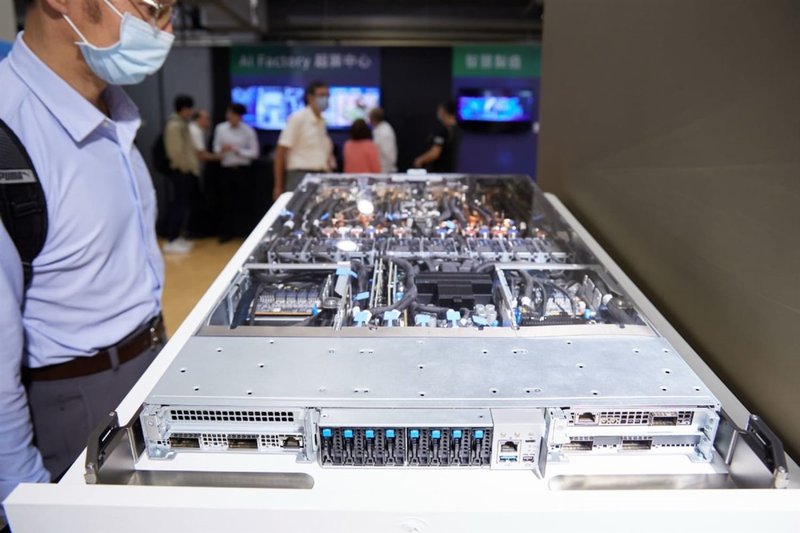
Pegatron, a key player in the global electronics manufacturing landscape, recently shared its projections regarding a significant acceleration in the expansion of the market for artificial intelligence servers. This outlook emerges at a crucial time for the company, which is finalizing a major internal reorganization. Pegatron's announcement underscores a broader market trend: the demand for hardware infrastructure capable of supporting increasingly complex AI workloads is steadily growing.
For companies operating with Large Language Models (LLM) and other artificial intelligence applications, the availability of high-performance servers is a critical factor. This expansion pertains not only to production capacity but also to innovation in hardware architectures, which is essential for managing the computational demands of training and inference.
The Context of AI Infrastructure Demand
The push towards adopting artificial intelligence across diverse sectors has generated unprecedented demand for specialized servers. These systems are designed to host high-performance GPUs, which are fundamental for accelerating operations such as training LLMs on massive datasets or performing low-latency inference. The need for high VRAM, memory bandwidth, and specific compute capabilities has become a standard requirement for many AI implementations.
The AI ecosystem demands not only raw computing power but also integrated solutions that can manage data throughput and optimize TCO. Deployment decisions, ranging from public cloud to self-hosted or hybrid solutions, are heavily influenced by the availability and specifications of these servers.
Implications for On-Premise Deployments and Data Sovereignty
The acceleration in AI server production, as anticipated by Pegatron, has direct implications for organizations prioritizing on-premise deployments. Opting for a self-hosted infrastructure offers significant advantages in terms of data sovereignty, regulatory compliance, and security—crucial aspects for sectors like finance, healthcare, or public administration. In these contexts, keeping data within one's physical or jurisdictional boundaries is often a non-negotiable requirement.
The availability of more powerful and potentially more accessible AI servers can lower the barrier to entry for companies wishing to build their local AI stacks, including air-gapped environments. This allows for granular control over hardware, software, and data pipelines, optimizing resources and managing the Total Cost of Ownership more predictably compared to cloud consumption-based models. For those evaluating on-premise deployment, AI-RADAR offers analytical frameworks on /llm-onpremise to assess the trade-offs between control, performance, and costs.
Future Outlook and Technological Challenges
The expansion of the AI server market, while promising, is not without its challenges. The supply chain, energy management, and the rapid innovation cycle of silicon represent critical factors. Companies must balance the need for cutting-edge hardware with the long-term sustainability and scalability of their infrastructures.
As Pegatron prepares to capitalize on this growth, the industry as a whole will continue to evolve, with new generations of GPUs and system architectures promising greater efficiency for LLM training and inference. The ability to integrate these innovations into robust and secure on-premise solutions will be paramount for enterprises aiming to maintain a competitive edge in the era of artificial intelligence.






💬 Comments (0)
🔒 Log in or register to comment on articles.
No comments yet. Be the first to comment!