Artificial Intelligence Serving Agriculture
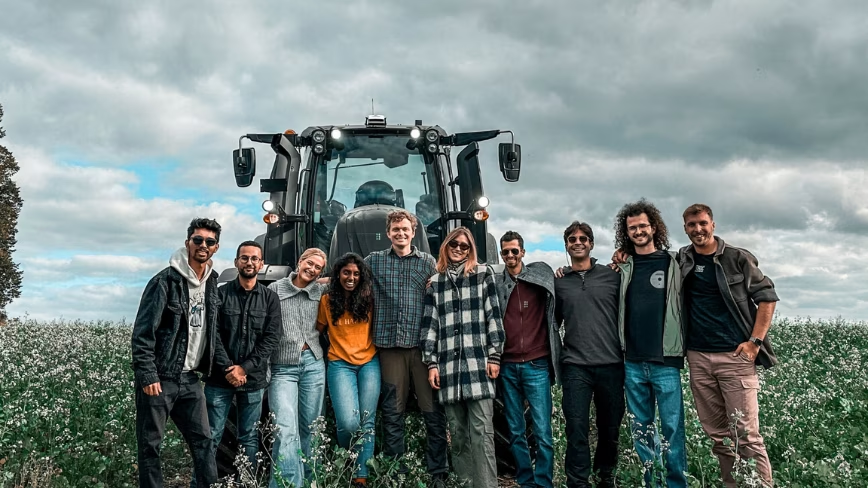
Copenhagen-based agtech startup PerPlant has announced a €1 million funding round. This capital is earmarked to support the expansion of its innovative technology, which aims to revolutionize precision agriculture through the deployment of AI-powered cameras directly installed on tractors. PerPlant's approach is distinguished by its conceptual simplicity: a device mounted on the tractor's roof, equipped with a camera monitoring the field and an AI system that processes data to guide operational decisions.
The company has already demonstrated the scalability of its solution, having mapped a European agricultural area nine times larger than the total area covered by all Danish agricultural drones combined. This achievement underscores the efficiency and reach of PerPlant's system. With the backing of prominent Nordic investors, the company's next strategic step is to enter the vast United States market, further solidifying its position in the sector.
Edge AI in Agriculture: Challenges and Opportunities
The core of PerPlant's proposition lies in implementing artificial intelligence systems directly on the tractor's onboard hardware, a prime example of Edge AI. This architecture implies that data collected by the cameras is processed locally, without the need to transmit large volumes of information to a remote cloud for analysis. Such an approach offers significant advantages in terms of latency, enabling near-instantaneous decisions, which are crucial for applications like targeted spraying or weed identification.
However, the deployment of AI solutions in Edge environments presents specific challenges. The hardware must be robust, resistant to the extreme environmental conditions typical of agriculture (dust, humidity, vibrations), and AI models must be optimized to operate with limited computational resources. This often requires techniques like Quantization to reduce model size and accelerate Inference while maintaining sufficient accuracy. Power management and intermittent connectivity are additional critical factors to consider to ensure system reliability in the field.
Implications for Data Sovereignty and TCO
The adoption of Edge AI solutions like PerPlant's has profound implications for data sovereignty and Total Cost of Ownership (TCO). By processing data locally, farmers retain greater control over their information, reducing risks associated with transmission and storage on external servers. This aspect is particularly relevant in a sector like agriculture, where data on fields and crops can represent a significant competitive advantage and is subject to privacy regulations.
From a TCO perspective, an Edge deployment may involve a higher initial investment (CapEx) for hardware acquisition but can reduce long-term operational costs (OpEx) by eliminating or minimizing connectivity and cloud processing expenses. For those evaluating on-premise or Edge deployments, AI-RADAR offers analytical frameworks on /llm-onpremise to assess the trade-offs between initial and operational costs, performance, and data sovereignty requirements. The choice between a drone-based approach (often requiring cloud processing) and a tractor-mounted system with Edge AI depends on various factors, including operational scale and infrastructure availability.
The Future of Smart Agriculture
PerPlant's initiative is part of a broader trend of digitalization and automation in agriculture, where artificial intelligence plays an increasingly central role. The ability to monitor and analyze fields with millimeter precision opens new frontiers for resource optimization, waste reduction, and productivity enhancement. The expansion into the US market represents a significant step for the company, allowing it to test and refine its technology on an even larger scale.
The success of these solutions will depend not only on technological advancement but also on their seamless integration into existing agricultural practices and the ability to demonstrate a clear return on investment for farmers. The combination of robust hardware, efficient AI models, and an intuitive user interface will be crucial for widespread adoption, outlining a future where tractors are not just machines for tilling the soil but intelligent platforms for agricultural management.









💬 Comments (0)
🔒 Log in or register to comment on articles.
No comments yet. Be the first to comment!