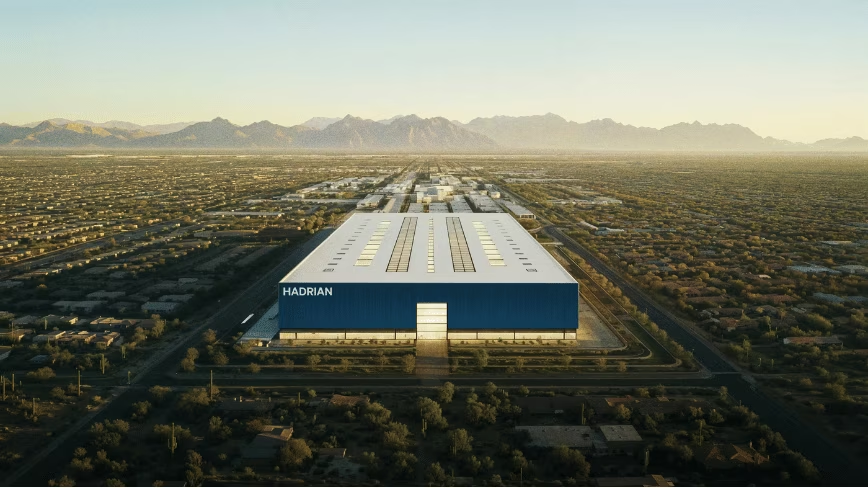
A dizzying rumor gets denied within hours – that’s nothing new. But when it involves a company like Hadrian Automation and a hypothetical one-billion-dollar funding round at a $7.5 billion valuation, it’s worth pausing to see what’s stirring beneath the surface. According to Bloomberg, the California-based startup – which builds hyper-automated factories for the defense sector – is in advanced talks to raise a record sum. Hadrian dismisses the report as “inaccurate.” Yet that number has already started circulating, shining a light on a phenomenon AI-RADAR tracks closely: the physical AI rush and its consequences for those architecting compute infrastructure.
AI that touches metal
When we talk about physical AI, we aren’t referring to Large Language Models (LLMs) confined to cloud data centers. Here, inference must happen within single-digit milliseconds of latency, on production lines, autonomous vehicles, or industrial robots. Hadrian’s factory is an extreme example: systems combining computer vision, robotics, and predictive quality control – all assets that demand on-site data processing for security, latency, and sovereignty reasons. The rumored round, despite the denial, signals that the market is betting heavily on this paradigm. And it’s no isolated case: the U.S. manufacturing supply chain reshoring, driven by industrial policy, is creating unprecedented demand for on-premise compute architectures capable of handling inference workloads and, eventually, fine-tuning of specialized models.
Why on-premise is back at the center
For those designing AI deployments outside the cloud, the Hadrian leak is a signal. Physical AI requires local stacks where processing runs on GPUs, FPGAs, or ASICs inside the industrial perimeter. No sensitive data transfer to external environments, strict compliance with regulations like GDPR and the emerging AI Act, and cost predictability that the pay-as-you-go model of cloud providers cannot guarantee. In this scenario, Total Cost of Ownership (TCO) is measured over multiyear cycles, including hardware maintenance, energy consumption, and regular upgrades. The factory becomes a node in a distributed network of inference servers, each optimized for specific vision or control models. AI-RADAR follows the evolution of these stacks, offering analytical frameworks for those choosing between cloud and on-premise in the /llm-onpremise section.
Beyond financial speculation
The point, therefore, isn’t whether Hadrian will close the round or not. It’s that the interest around its name reflects a structural shift: AI is no longer just a digital phenomenon. It’s entering the physical value chain, and this forces a rethink of infrastructure. Companies already managing production lines are evaluating servers with high-VRAM GPUs, NVLink connections to accelerate module-to-module communication, and orchestration frameworks like vLLM or TGI adapted for the edge. The goal is not to replace the cloud but to complement it with self-hosted solutions where operational constraints demand it. The Hadrian news, even if denied, is a symptom of a transformation that is redrawing the boundaries between IT and OT. For those working in on-premise AI, it’s confirmation that the next front of innovation won’t be in a remote data center, but on the factory floor.






💬 Comments (0)
🔒 Log in or register to comment on articles.
No comments yet. Be the first to comment!