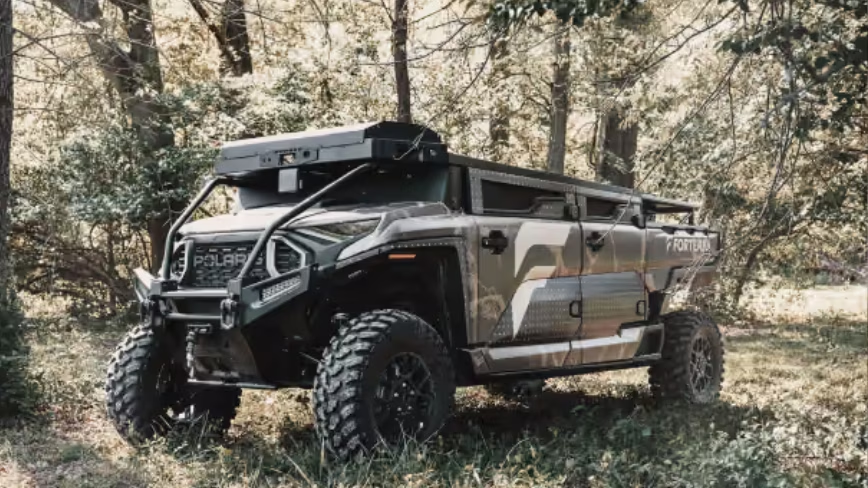
Since October last year, more than a hundred U.S.-built autonomous all-terrain vehicles have been operating in Ukrainian combat zones. The disclosure came from Forterra, a company specializing in autonomous vehicles, which calls it "the largest deployment of autonomous ground vehicles in combat by any US defence tech company." Beyond the battlefield headline, it’s a litmus test for where AI inference is heading when it must work without the cloud, under electromagnetic stress and with lives on the line.
Onboard hardware was not detailed, but the constraints are obvious: each ATV must perceive its environment, plan routes, and avoid obstacles in real time with no reliable external connectivity. No data centers are within latency range, GPS may be denied, radios jammed. All intelligence must run locally. It’s an extreme version of what on-premise deployment practitioners know well: data sovereignty, information flow control, and zero external dependencies. Here it’s not about GDPR compliance, but operational survival.
From an infrastructure standpoint, this kind of autonomy pushes the edge of ruggedized accelerator inference, with high memory bandwidth and low power draw. Though specifics remain classified, it’s plausible the vehicles use embedded systems with GPUs or FPGAs running perception stacks based on neural networks, fusing data from cameras and LiDAR. The need to work in adverse environments—dust, mud, temperature swings, vibration—forces hardware choices that many cloud-first vendors would never consider.
The structural implications go beyond the battlefield. The success of these assets signals that off-grid AI is mature enough for mass deployment in high-risk scenarios. For the defense sector, this accelerates the shift toward autonomous platforms, reshaping procurement and doctrine. For the enterprise, the lesson is that local inference, even without stable connectivity, is no longer a stopgap until better networks arrive: it’s a strategic asset. Those building solutions for industry, logistics, or critical infrastructure surveillance can look at these ATVs as proof that truly autonomous AI demands hardware designed to operate where the cloud can’t reach.
There’s also a second-order effect on semiconductor suppliers and edge-AI operating systems. The scale and duration of this deployment generate real-world operational data at large scale—gold dust for optimizing models and hardware-software integration under extreme conditions. Companies that can mine this data stand to gain an edge in civilian sectors too, where robust on-premise inference becomes a competitive differentiator.









💬 Comments (0)
🔒 Log in or register to comment on articles.
No comments yet. Be the first to comment!