When a company specialized in thermal and power components announces that its server-related revenue share has reached double digits, the signal is clear: the race for AI infrastructure is reshaping even the most peripheral markets. Potens, a known name in the semiconductor supply chain, has officially expanded into cooling and power solutions designed for AI workloads. The news comes from DIGITIMES, a publication that keeps a close eye on Asian supply chain shifts, and it suffices to illustrate how demand for AI servers is creating ripples in sectors seemingly distant from silicon.
A market that runs hot (literally)
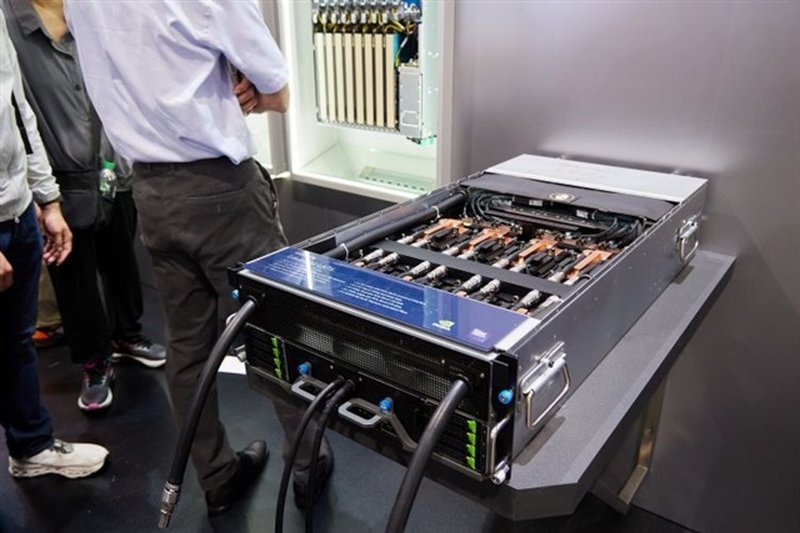
GPU clusters used for training and inference of Large Language Models not only crave computation — they dissipate heat in amounts that, until a few years ago, were confined to supercomputers. A single NVIDIA H100 card can exceed 700 watts of thermal design power, and when eight of them are placed in a node, traditional air cooling starts to show its limits. That is why Potens' entry — with solutions spanning from single-phase liquid cooling to high-efficiency power delivery — touches a raw nerve for those building on-premise infrastructure.
The role of cooling in on-premise deployments
Those who choose to keep their models in-house, for data sovereignty or cost predictability, must directly manage the physics of the data center. In a self-hosted scenario, power density per rack is rising quickly: exceeding 20-30 kW per rack in configurations dedicated to inference or fine-tuning is not uncommon. Without an adequate thermal dissipation strategy, the risk is having to underutilize hardware, reducing the performance-to-capital ratio. Liquid cooling solutions, like those Potens is investing in, enable lower operating temperatures, prolong component lifespan, and allow higher utilization levels. It is a link in the chain that directly affects TCO, often overlooked in comparisons that put only CPU and GPU at the center.
Beyond silicon: efficient power as an enabler
The announcement is not only about heat but also about power. The efficiency of DC-DC converters and the stability of power lines are silent factors that determine overall system reliability. In on-premise environments, where redundancy and operational continuity are managed internally, a failure caused by a power spike can trigger costly downtime. Having components designed specifically for the irregular load profiles typical of training pipelines — with consumption peaks when the GPU works at full capacity — reduces the risk of outages and simplifies electrical infrastructure sizing. Potens is not new to such challenges, having supplied components for traditional servers for years, but adapting to the AI market shows how quickly the supply chain is specializing.
The market signal: double digits that speak
When a company declares that the server segment now accounts for a double-digit share of its revenue, it means that niche has become a pillar. We do not know the exact number — the source does not specify it — but the indication is enough to confirm that demand for thermal and power components for AI servers is no longer experimental. Companies like Potens, often in the back seat compared to big chip names, are finding their centrality in an ecosystem that, to function, needs much more than mere computing power. It is a signal that IT decision-makers, especially those evaluating on-premise deployment, should read carefully: the availability of mature cooling solutions and competition in the sector can accelerate cost reductions, making the self-hosted option even more competitive versus cloud for stable or sensitive workloads.
For anyone sizing a local cluster for LLMs today, it becomes crucial to evaluate the entire thermal and electrical chain, not just the GPU datasheet. Potens' expansion is a piece that makes that puzzle a little clearer.








💬 Comments (0)
🔒 Log in or register to comment on articles.
No comments yet. Be the first to comment!