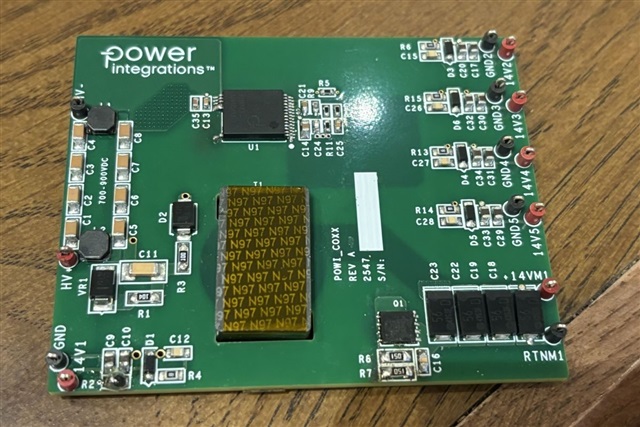
Power Integrations' Innovation for AI Data Centers
Power Integrations, a leading company in the power conversion semiconductor sector, recently unveiled a new 1700V Gallium Nitride (GaN) auxiliary power supply unit (PSU). This solution has been specifically developed to meet the growing demands of artificial intelligence data centers, a rapidly expanding sector that requires increasingly powerful and efficient infrastructures.
The announcement underscores the importance of component-level innovation to support the evolution of AI workloads. With the increasing complexity and scale of Large Language Models (LLM) and other AI models, the demand for energy and the need for optimal thermal management in data centers become paramount. Auxiliary PSUs play a fundamental role in powering control circuits and other critical functions within high-power systems, such as GPU cards.
The Advantage of Gallium Nitride (GaN) in PSUs
The choice of Gallium Nitride (GaN) as the semiconductor material for this new PSU is not accidental. GaN offers significant advantages over traditional silicon, particularly for high-frequency and high-power applications. GaN devices exhibit higher energy conversion efficiency, lower resistance, and the ability to operate at higher temperatures, which translates into less heat dissipation.
These characteristics enable the creation of more compact, lighter PSUs with better power density. For AI data centers, where space is precious and the amount of energy required is enormous, the efficiency of every single component is crucial. A 1700V GaN PSU can help reduce the overall energy losses of the system, improving power stability and reliability for the complex hardware architectures used for LLM Inference and training.
Implications for On-Premise Deployments and TCO
For CTOs, DevOps leads, and infrastructure architects evaluating on-premise deployments for AI workloads, the efficiency of GaN PSUs has a direct impact on the Total Cost of Ownership (TCO). Higher efficiency means lower energy consumption, which translates into reduced electricity bills and less need for cooling infrastructure. This is particularly relevant for self-hosted or air-gapped installations, where every watt saved contributes to optimizing operational costs and reducing the environmental footprint.
The ability to handle high voltages like 1700V is essential for powering high-performance GPU arrays, such as NVIDIA H100 or A100, which require a robust and stable power supply. The adoption of these technologies allows for building denser and more scalable AI infrastructures, maximizing the utilization of physical space and available energy resources. Hardware decisions, including power components, are therefore strategic to ensure data sovereignty and complete control over the computing environment.
Future Prospects and Strategic Choices in AI
The introduction of high-voltage GaN PSUs by Power Integrations reflects a broader trend in the industry: the pursuit of increasingly efficient and performant hardware solutions to support the exponential growth of artificial intelligence. For companies investing in AI computing capabilities, choosing the right components is fundamental to balancing performance, costs, and sustainability.
This type of innovation is a concrete example of how advancements in semiconductors directly influence the feasibility and cost-effectiveness of large-scale AI deployments, especially in on-premise contexts. For those evaluating self-hosted alternatives versus the cloud, understanding the trade-offs and benefits offered by technologies like GaN is crucial. AI-RADAR continues to monitor these evolutions, providing in-depth analyses of the frameworks and infrastructures needed to build and manage local AI stacks, with a focus on data sovereignty and TCO.






💬 Comments (0)
🔒 Log in or register to comment on articles.
No comments yet. Be the first to comment!