
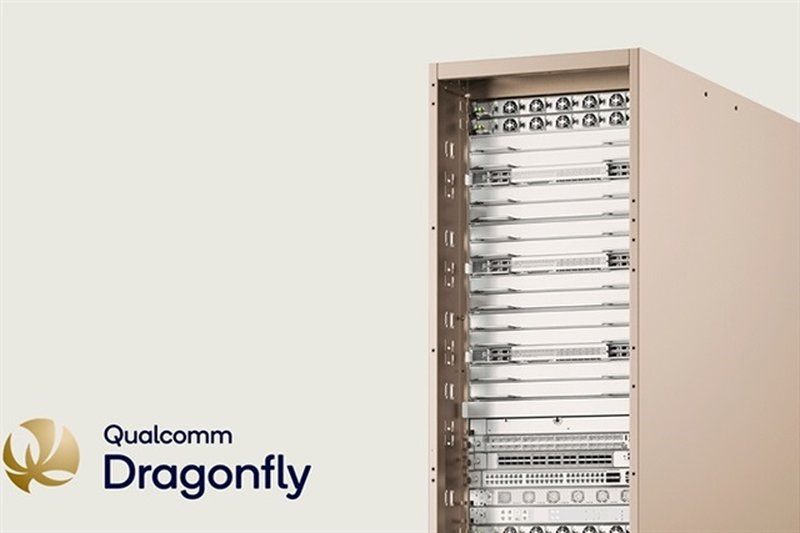
The open-source AI ecosystem just got a new hardware building block: Qualcomm has announced the integration of its Dragonfly data center systems into its existing partnership with Hugging Face. The move shifts the spotlight from software to infrastructure, opening practical scenarios for organizations that want to run LLMs on hardware they own, within their own facilities.
Dragonfly in the Data Center: Efficiency and Scale
Dragonfly systems represent Qualcomm’s answer to the growing demand for AI inference horsepower in enterprise environments. While detailed technical specs have yet to be disclosed, the platform’s logic is clear: deliver an efficient alternative to traditional GPUs, drawing on the company’s long-standing expertise in low-power chip design. For those running large-scale machine learning workloads, this translates into potentially lower operational costs and higher compute density per watt – a decisive factor when evaluating the Total Cost of Ownership (TCO) of an on-premise deployment.
The Hugging Face integration is no accident. The French platform has become the go-to hub for distributing and fine-tuning open-source LLMs, from compact open-weight models to larger architectures. Enabling these models to run natively on Qualcomm hardware removes a compatibility barrier that often discourages companies from moving toward local stacks. Instead of wrestling with complex adaptation pipelines, teams can rely on a pre-tested ecosystem.
Impact on Self-Hosted Choices
For organizations bound by privacy constraints, data sovereignty requirements, or simply a TCO calculation that favors keeping inference workloads inside their own data centers, this announcement carries real weight. Pairing Qualcomm infrastructure with Hugging Face’s model library reduces dependency on public cloud and makes it easier to build air-gapped, isolated environments.
From an AI-RADAR perspective, the coupling of energy-efficient accelerators with models that can be optimized via quantization (such as FP16 or INT8) is a strategic junction. On one side, power-sipping hardware lets you scale workloads without ballooning energy bills; on the other, the availability of pre-trained, fine-tuning-ready models on Hugging Face democratizes access to capable LLMs even for organizations without massive research budgets. The trade-off, as always, lies in balancing raw performance against running costs: Qualcomm systems may not match the absolute peak throughput of certain GPU offerings, but they compensate with a modest thermal profile and predictable infrastructure expenses.
A Clear Direction for the Market
The partnership’s expansion signals a convergence between specialized hardware and open software platforms that goes beyond a single commercial deal. As the industry grapples with how to make large-scale inference sustainable, moves like this sketch a viable path: purpose-optimized hardware matched with a development ecosystem that doesn’t require rewriting every component from scratch.
For anyone evaluating on-premise LLM deployment today, the message is twofold. First, vendors are investing in solutions that make local inference not just possible but economically rational. Second, hardware choices can no longer ignore compatibility with the frameworks and libraries driving open-source research. The next generation of AI data centers will be won as much on silicon as on how smoothly models and applications flow from training to inference without friction.









💬 Comments (0)
🔒 Log in or register to comment on articles.
No comments yet. Be the first to comment!