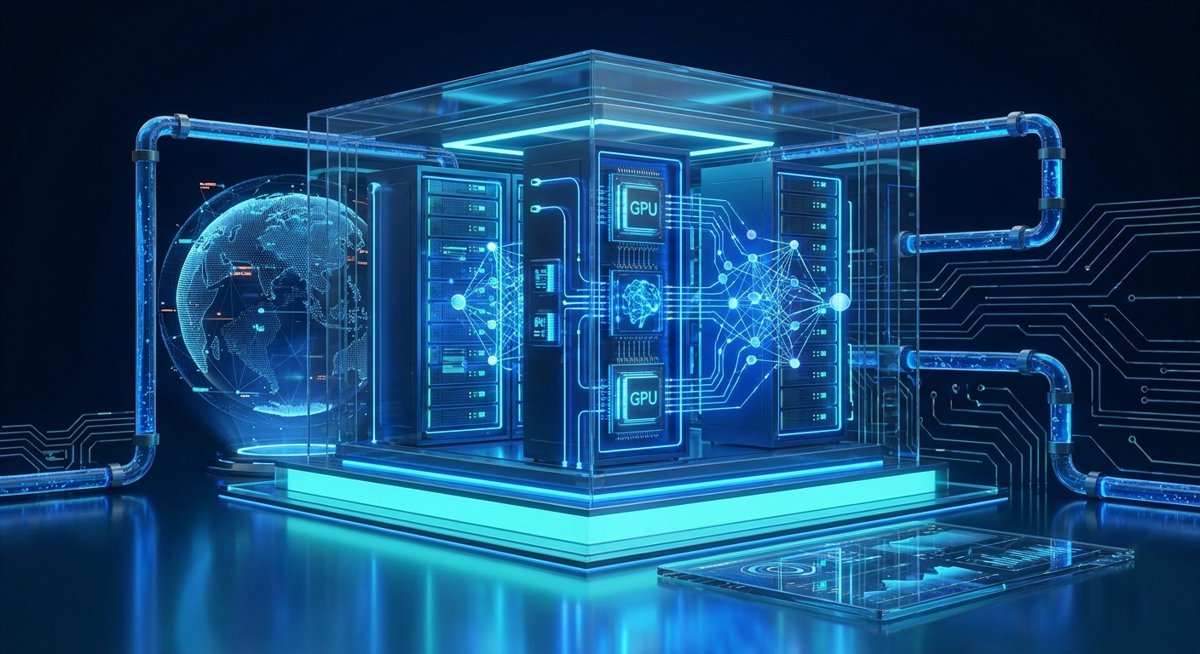
An architecture that blurs the boundary between interface and system
Denial is not just yet another Wayland compositor written in Rust. The project, designed specifically for Arch Linux, directly merges the Flutter engine into the compositing process, eliminating the traditional decoupling between application toolkit and display server. In a normal stack, a Flutter app on Linux talks to the compositor via the Wayland protocol, requiring serialization, shared buffers and separate rendering contexts. Here, Flutter’s logic and compositing run in the same address space and share graphics primitives.
For those managing on-premise systems – especially those hosting local inference pipelines – this architectural choice reshuffles the trade-off calculus. On a single-board computer running a quantized LLM, every megabyte of RAM and every GPU cycle counts. Eliminating an intermediate process and its buffers frees resources that can be dedicated to the model itself, reducing the risk of swapping or performance degradation when the user interface coexists with computationally heavy workloads.
The explicit targeting of Arch Linux is telling: Denial is not aiming for a generic desktop but for an environment where the developer or system administrator retains granular control over the entire stack. In a DIY AI setup, where hardware is often assembled and software compiled from source, a modular and integrated compositor can reduce the number of components to maintain and update, simplifying the lifecycle of the system.
The closeness between interface and graphics system also brings more predictable rendering times. Animations, overlays and UI elements do not travel through external message queues but are handled directly by the compositor as native events. In a dashboard displaying real-time logs from on-premise training or the output of an analysis pipeline on sensitive data, this visual immediacy improves the operator experience and reduces the chance of jitter that could be misinterpreted as system malfunction.
What it means for local AI: fewer layers, more cycles for the model
A recurring theme in architectures for local inference is the tension between resources dedicated to the model and ancillary services. On an edge device exposing a REST API for a self-hosted LLM, the user interface is often a neglected component, yet it is precisely where operators, technicians or customers interact with the system. Denial reminds us that efficiency is not measured only in token throughput, but also in the responsiveness of the entire stack during real use.
The co-located architecture allows workload consolidation: the same process that paints windows can also display model results without relying on a web browser or a separate application. In an industrial AI scenario, where interfaces are often static or widget-based, saving hundreds of megabytes of RAM compared to an Electron app or a generic compositor with a separate Flutter client is tangible and translates into lower hardware cost per deployed unit.
From a TCO perspective, a leaner compositor also reduces the attack surface and the update burden. If the whole UI system is compiled in Rust and integrated with the graphics server, the number of external dependencies shrinks. In regulated environments where software validation is mandatory, this means fewer components to certify and a more straightforward change management path. Denial does not solve data governance, but it shows how even the last segment of infrastructure can align with principles of minimization and control.
It should be noted that proximity between rendering and application logic is not entirely new: embedded systems and interactive kiosks have long sought it for cost and reliability reasons. However, the use of Rust and a modern framework like Flutter brings this practice into new territory, where memory safety and explicit concurrency management become non-negotiable requirements even in a compositor. If the same codebase were to power interfaces for monitoring a GPU cluster running model training, a memory-safe codebase would help contain the risk of silent crashes.
Rust, Smithay, and the security side of on-premise interfaces
The choice of Rust and the Smithay library is not a minor detail. Smithay provides building blocks for constructing Wayland compositors in a modular fashion, leaving the developer in charge of buffer composition, input handling and layout. Denial inherits this modularity and extends it with deep Flutter integration, while keeping the language’s guarantees: no memory corruptions, compile-time prevention of data races, and an ownership model that eases parallelization.
For those deploying LLMs in sensitive contexts – think self-service banking kiosks, clinical workstations or factory control panels – the compositor is no longer a mere accessory but a component with direct access to video memory and, in extreme cases, to other Wayland applications’ buffers. A security bug at this level can expose data that should remain confined. Denial being written entirely in Rust eliminates a class of vulnerabilities historically exploited in display servers, such as buffer overflows during command or font parsing.
This focus on security is part of a broader movement affecting hypervisors, container runtimes and embedded operating systems. Rust is increasingly the language of choice for rewriting critical components where correctness matters more than initial development speed. In the on-premise AI perimeter, where training or inference data must never leave the device, a robust compositor can become part of the trust chain, especially if certifiable against standards like Common Criteria or integrated into security-oriented Linux distributions.
Moreover, Smithay’s modularity makes it possible to disable unnecessary features, further shrinking the attack surface. In a kiosk application running on an edge node, the compositor could be configured to support exactly one full-screen window and a minimal set of protocols, excluding everything else. This “reduce and harden” approach is familiar to server hardening practitioners, but less common in the GUI world. Denial makes it feasible through configuration rather than code patches, lowering the barrier for integrators.
The Flutter–compositor short circuit: implications for dashboards, kiosks and industrial panels
Normally, Flutter on Linux uses a specific backend to interact with the display server. Flutter composes its own scene into a surface that it then hands off to the compositor. With Denial, that step is absorbed inside the compositor itself, which understands the structure of Flutter surfaces and can re-render them without costly format conversions or DMA-BUF buffer negotiations. The difference is not just about performance but about architecture: the compositor can decide to animate a Flutter widget exactly as if it were a native decoration, minimizing extra work.
In a monitoring scenario for an inference system, this integration means being able to update metrics, charts and logs with a predictable GPU load, even on hardware lacking dedicated accelerators like Raspberry Pi or units with Mali GPUs. The ability to share data structures between the model and the interface – for instance, model output buffers already in image format – without going through IPC between user memory and compositor memory becomes a tangible benefit for the whole stack.
Another relevant aspect is reduced interaction latency. In a self-service banking application using a local LLM to answer user queries, the time between touching a button and the start of the response animation is perceived as part of the user experience. By eliminating the round-trip through the native Wayland backend for Flutter primitives, Denial can make these micro-interactions more immediate, improving the end user’s perception of system reliability.
However, this tight integration imposes a flexibility cost. A Flutter application running on Denial cannot work on a standard compositor without adaptation, unless a version with a classic Wayland backend is also exposed. Anyone adopting Denial for an industrial product accepts tying their stack to a component that is not yet widespread, weighing whether the efficiency gains compensate for the risk of vendor lock-in and the need to maintain a compositor fork if bugs or incompatibilities with future Flutter versions arise.
Which trade-offs remain open and who benefits
Denial is a young project with a small community and still experimental adoption. For production workloads, there are no public metrics on stability, power consumption or compatibility with different GPU drivers – critical information for anyone sizing an on-premise fleet. Moreover, the deep Flutter integration requires the development team to be proficient in Rust, Wayland and Google’s framework: a skill mix not trivial to find.
From a TCO standpoint, any hardware resource savings must be weighed against development and maintenance costs. On a deployment of a few dozen identical units, build automation and image standardization could absorb the initial costs; at larger scale, the need to update Flutter in lockstep with the compositor could introduce non-negligible integration overhead. Organizations with DevOps teams already versed in compilation pipelines for embedded environments might benefit most, while system integrators looking for turnkey solutions may remain cautious.
Potential winners of an architecture like Denial are builders of industrial and medical appliances that ship a complete firmware: once the compositor version is frozen, regression risks are manageable and one gains in performance and security. Conversely, developers targeting a generic Linux ecosystem (such as a developer-oriented distribution) might prefer to keep portability and avoid coupling to a single compositor.
One must also consider competition from similar approaches. Weston, the reference Wayland compositor, is already exploring integration with toolkits like Qt or Vulkan rendering backends. If these integrations matured and gained support, Denial’s differentiation would shrink. However, the key distinction remains having the Flutter engine – not a generic one – co-located, a level of integration that no other compositor currently offers natively. For interfaces already using Flutter (and many do in the mobile and embedded space), this is a real advantage.
Signals to watch: when the compositor enters the on-premise AI supply chain
Denial does not introduce features directly related to artificial intelligence, but it is a wake-up call for those designing local infrastructures. The message is that even the UI layer is becoming a critical node in the supply chain, no longer freely interchangeable. The choice of a compositor can influence overall system performance, certifiability and attack surface – parameters that an on-premise plant manager can no longer ignore.
One signal to monitor is the evolution of the Smithay project and the possible emergence of other experimental compositors integrating specific rendering engines for AI applications. If the Denial pattern were replicated with other technologies – for instance, a compositor that natively understands tensor visualization primitives – a season would open where the GUI becomes an accelerator for the data scientist, not a passive terminal.
Another indicator is the growth of support for ARM and RISC-V GPUs within these compositors. As edge hardware for inference diversifies, a compositor’s ability to run uniformly across architectures, without requiring closed binary drivers, becomes an enabling factor for deployments in isolated environments. Denial, being open source and Rust-based, could be ported with relative ease to non-x86 platforms, provided Flutter and Smithay support the necessary backends.
Finally, it is worth keeping an eye on how IoT- and edge-oriented Linux distributions – not just Arch, but also Yocto or Buildroot – will start including precompiled packages of compositors like Denial. Availability in official repositories dramatically lowers the adoption barrier and turns an engineering experiment into a system component evaluable for real products. Should that happen, the integration between interface and local AI will no longer be just a forward-looking architectural choice, but a standard piece of the on-premise stack.



💬 Comments (0)
🔒 Log in or register to comment on articles.
No comments yet. Be the first to comment!