Europe’s rearmament drive has a new, increasingly central yet invisible protagonist: autonomous drones. Quantum Systems, a Bavarian company founded in 2015, today announced a $1.2 billion Series D funding round that lifts its valuation to $8 billion, more than double the figure from its previous round in November 2023, when it was valued at over €3 billion. The investment was co-led by Blackstone, Noteus, Airbus and Advent, with backing from institutional investors including Bond, Fidelity and Elephant Lake Ventures.
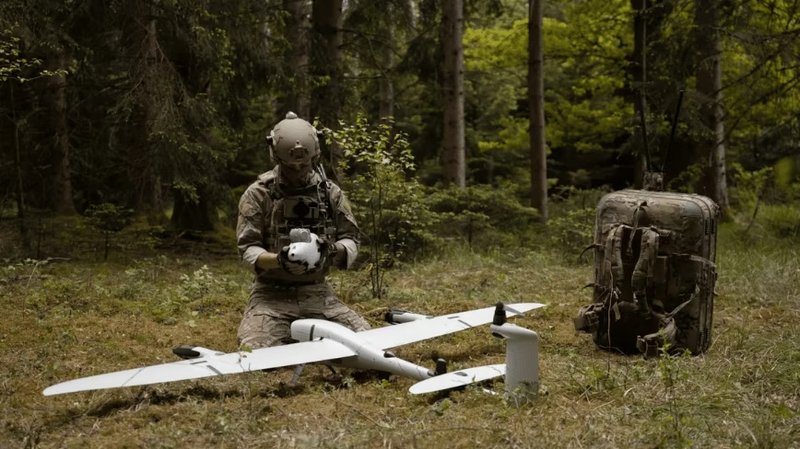
Florian Seibel, co-founder and co-CEO, does not mince words: “The future is unmanned. Defence will be defined by autonomous systems that can operate together across domains in real time.” This statement is rooted in operational reality: Quantum Systems’ aircraft are deployed by NATO forces in Europe, the United States, Australia and New Zealand, and most prominently in Ukraine, where its fleet has been active since the full-scale invasion began in 2022.
The fresh capital, the company said, will fund international expansion, possible acquisitions and increased manufacturing capacity. The backdrop is a Europe that is structurally ramping up defence spending, and demand for unmanned systems is rising in tandem. Seibel also floated the idea of a merger with Stark, a maker of armed drones that he also co-founded, though he stressed that there is currently “no roadmap” for such a move. “I was never really happy that I was forced to build Stark outside of Quantum,” he told the Financial Times. “Stark did great. It’s a success story. But if it was part of Quantum, there also would be benefits coming out of that.”
Beyond the financial headline, the round signals a deeper shift in how military technology is conceived. Drones are no longer simple remote-controlled reconnaissance tools: they are becoming autonomous platforms that must process vast amounts of data in real time, make tactical decisions and coordinate with other systems, often in environments without stable connectivity. This demands an architectural model that closely mirrors the requirements of on-premise deployments in the enterprise world: processing must happen locally, on the device, to ensure minimal latency, data security and continued operation even when the cloud is unreachable. It is no coincidence that the defence sector is pushing toward increasingly sophisticated edge computing solutions, where artificial intelligence runs directly on board the drone, far from vulnerable remote servers.
For those evaluating AI deployment strategies, the parallel is immediate. At AI-RADAR, we have long explored the trade-offs between cloud and on-premise for Large Language Models and other critical workloads. The Quantum Systems case shows how, in domains where data sovereignty and reactivity are matters of life and death, local processing is non-negotiable. And if a military drone cannot afford to wait for a response from a distant data centre, the same principle applies to industrial, healthcare or financial infrastructure that handles sensitive information or must react in fractions of a second.
With more than $1.2 billion in “dry powder,” as Seibel put it, Quantum Systems aims to become what the CEO calls a “next-generation neo prime” capable of reshaping the sector. It remains to be seen whether the integration with Stark will materialise and how the growth of autonomous defence will influence the underlying technology architectures. What is certain is that drones are no longer mere terminals: they are increasingly miniature data centres, with computing demands that bring them closer to the systems many enterprises are now starting to run in-house.








💬 Comments (0)
🔒 Log in or register to comment on articles.
No comments yet. Be the first to comment!