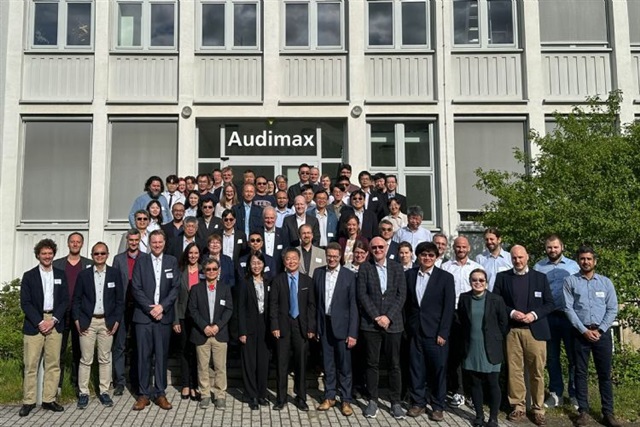
Extension of EV Battery Collaboration
Taiwan and Germany have announced the extension of their joint research and development (R&D) collaboration in the field of electric vehicle (EV) batteries. The agreement, involving entities such as the NSTC, will prolong joint activities until 2029. This strategic partnership underscores the growing importance of battery technologies in the global landscape of innovation and energy transition.
Although the source does not specify the methodological details of the research, it is increasingly common for R&D projects of this scale to integrate advanced tools, including artificial intelligence. AI, and particularly Large Language Models (LLM), are revolutionizing how scientists and engineers approach complex problems, from the discovery of new materials to the optimization of manufacturing processes.
The Potential Role of AI in Materials Research
The application of artificial intelligence in materials science and battery engineering offers significant prospects. LLMs and other machine learning models can analyze vast datasets of material properties, simulate chemical reactions, and predict the performance of new compositions with speed and precision unimaginable just a few years ago. This significantly accelerates the discovery cycle, reducing the time and costs associated with physical experimentation.
For instance, AI can be used to identify promising material candidates for electrodes, optimize electrolytes, or predict battery degradation under various operating conditions. The ability to process and correlate information from thousands of scientific publications and experimental data makes AI an indispensable tool for maintaining a competitive edge in high R&D intensity sectors like EV batteries.
Implications for On-Premise AI Deployments
The integration of AI into critical R&D projects such as the one between Taiwan and Germany raises fundamental questions regarding deployment infrastructure. The data generated and used in these contexts – proprietary formulas, experimental results, predictive models – are often considered high-value intellectual property. The need to ensure data sovereignty, regulatory compliance, and security against unauthorized access drives many organizations to consider self-hosted deployment solutions for their AI workloads.
An on-premise deployment allows for granular control over the entire data pipeline and models, including the ability to operate in air-gapped environments for maximum security. This approach requires careful hardware planning, such as high-performance GPUs with sufficient VRAM for LLM inference and fine-tuning, and a thorough evaluation of the Total Cost of Ownership (TCO). For those evaluating on-premise deployments, analytical frameworks are available on /llm-onpremise that can help assess the trade-offs between initial CapEx and long-term OpEx, performance, and security requirements.
Future Prospects and Strategic Choices
The decision to extend the collaboration between Taiwan and Germany reflects a long-term commitment to EV battery innovation. Should AI play an increasingly central role in this and similar R&D initiatives, infrastructure choices will become critical. Opting for an on-premise deployment offers advantages in terms of control, security, and potentially optimized TCO for intensive and predictable workloads. However, it requires significant initial investment and internal expertise for management.
Conversely, cloud solutions offer flexibility and scalability but may involve compromises on data sovereignty and unpredictable long-term operational costs. The key for CTOs and infrastructure architects lies in balancing these factors, choosing the approach that best aligns with the project's strategic objectives, budget constraints, and security requirements. The ability to manage LLMs and other AI models efficiently and securely will be a critical factor for the success of future R&D initiatives.









💬 Comments (0)
🔒 Log in or register to comment on articles.
No comments yet. Be the first to comment!