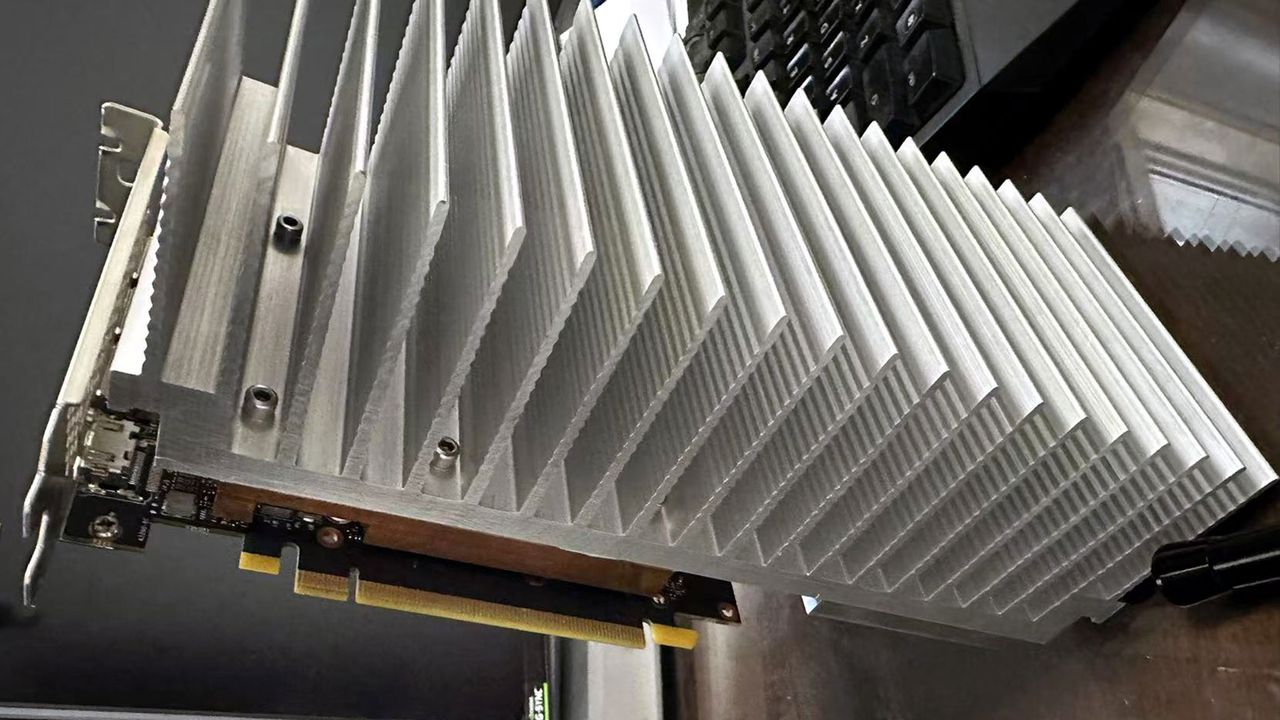
A PC enthusiast bolt a 5.5-pound aluminum heatsink onto an RTX 4060 graphics card, ditching fans entirely. The testbench-style setup relies solely on natural convection to dissipate heat and, as reported, handles typical open-air workloads without issue. A forum curiosity? Perhaps, but behind the gesture lies a reasoning that touches closely anyone designing inference nodes for LLMs in on-prem or edge contexts.
The RTX 4060, with its 115 W TDP, isn't the hungriest GPU around, but passive cooling remains a challenge: manufacturers favor active solutions to contain size and cost, accepting noise and mechanical failure points. The modder flipped the perspective, choosing thermal mass and radiating surface area over forced airflow. The result is a system that, while bulky, eliminates moving parts, reduces acoustic emissions to zero, and lowers the risk of fan-failure downtime.
Such a device will never enter a traditional data center, but it perfectly describes the needs of those running self-hosted language models in offices, labs, or non-soundproofed cabinets. LLM inference, especially with 4- or 8-bit quantized models, doesn't continuously saturate the GPU: the load comes in bursts, with wide thermal margins between prompts. An oversized aluminum mass can absorb peaks and slowly shed heat, never reaching critical temperatures. Zero noise becomes a concrete advantage when hardware shares space with people.
There's a structural signal here. The industry is already exploring fanless AI appliances for edge computing, driven by the need to operate in dusty, humid, or simply quiet environments. Projects like this, though hobby-born, show that passive cooling isn't a frivolity but a viable design choice for specific workloads. Those evaluating small-scale on-prem deployments today might ask how much mechanical simplicity affects total cost of ownership: fewer wear-prone components mean fewer maintenance interventions and longer operational life.
It's not all rosy: a 5.5-pound heatsink imposes mechanical constraints on the motherboard and case, and natural convection requires unobstructed airflow around the system, hard to guarantee in crowded racks. Moreover, sustained loads like distributed training remain out of reach. But for anyone running local inference with 7- or 13-billion-parameter models, the idea of a fanless GPU is no longer science fiction. And the line between extreme modding and industrial design gets blurry when deployment constraints push toward solutions mainstream vendors still ignore.





💬 Comments (0)
🔒 Log in or register to comment on articles.
No comments yet. Be the first to comment!