REPS' Innovation: Energy from Road Traffic
Tyrol-based startup REPS has announced a significant $23.6 million equity financing round, aimed at boosting the scalability of its patented Road Energy Production System. This technology, described as a "road power plant," is designed to convert kinetic energy generated by vehicle traffic into electricity. REPS' approach stands out in the renewable energy landscape, traditionally focused on sources like solar and wind, by instead proposing the recovery of existing energy that would otherwise be wasted.
The system integrates directly into existing road infrastructure, capturing energy produced by passing trucks and cars. A crucial aspect of the design is its ability to operate without causing disruptions to traffic flow or logistics operations. This feature makes it particularly appealing for high-traffic environments where operational efficiency is a priority.
Technical Details and Operational Advantages
Every day, a considerable amount of energy is dissipated in the form of motion, pressure, and vibration. On roads, this loss is constant, predictable, and concentrated in specific points, such as entrances, exits, curves, speed-limited zones, and loading areas, where heavy vehicles naturally slow down. REPS was conceived to recover this wasted mechanical energy and transform it into clean electricity at scale, leveraging existing infrastructure.
The technology proves particularly effective where vehicles are forced to slow down or brake, or where slopes increase the force exerted. REPS claims its converter delivers 254 times higher efficiency than the next-best alternative currently on the market. Unlike weather-dependent renewables, REPS' system operates independently of the time of day and weather conditions, ensuring more stable and predictable energy production. The company has also designed the system for superior durability, with an estimated operational life of over 20 years and an amortization period of just a few years, a key factor for the Total Cost of Ownership (TCO) in industrial contexts.
Pilot Projects and Scaling Potential
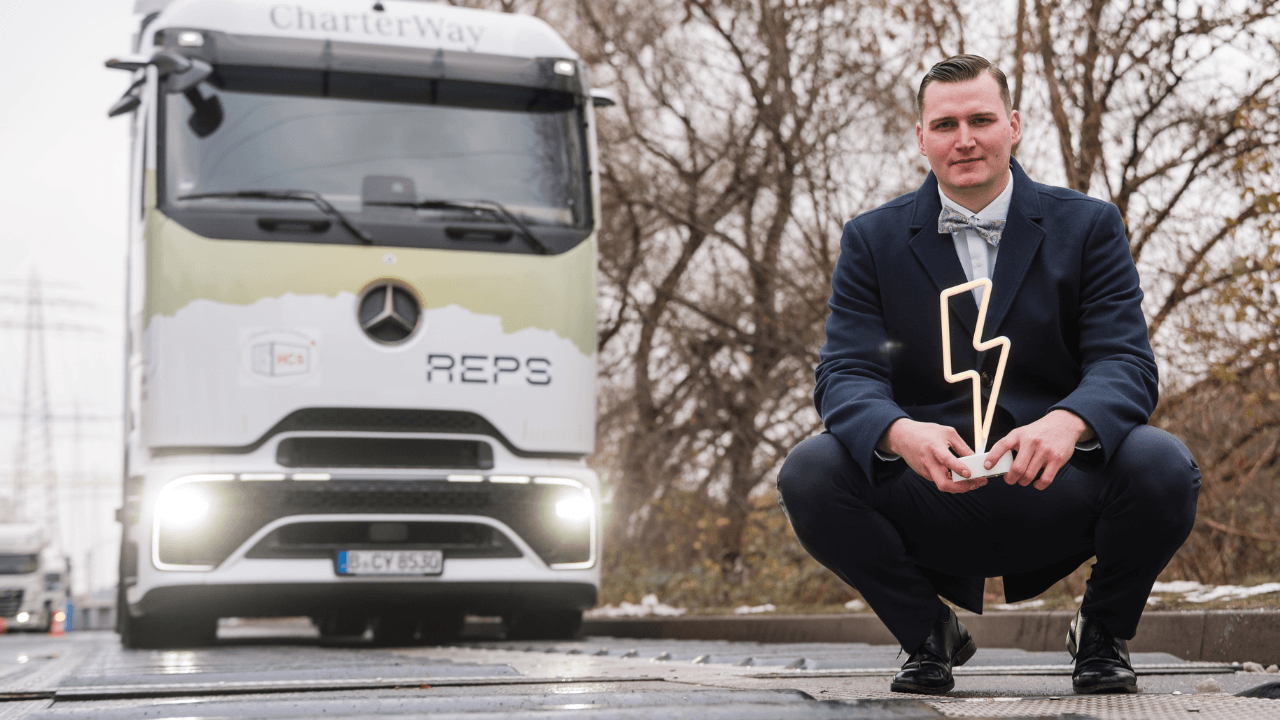
The first commercial REPS system has been operational at the Port of Hamburg since November 2025. Since then, it has recorded the passage of over 115,000 trucks, generating more than 6,700 kWh of electricity under real traffic conditions. This initial deployment has generated strong international demand, with the company engaging with over 90 parties from the port industry alone across Europe, the Middle East, Asia, and North America. Interest is also expanding beyond ports to include logistics hubs and cities.
REPS' estimates illustrate the technology's scalability potential. A rollout of approximately 230 systems across the Port of Hamburg's public roads, excluding terminals, could generate around 10 GWh of electricity per year. This amount would be sufficient to power approximately 2,800 households and offset roughly 9.81% of the CO₂ emissions caused by port traffic, with a return on investment (ROI) below four years. On a city scale, the company estimates that deploying around 64,000 systems in a city the size of Dubai could recover approximately 3.2 TWh of electricity annually, equivalent to about 10.8% of the city’s total energy consumption today.
Towards a Decentralized Energy Future
Alfons Huber, founder and CEO of REPS, emphasizes how roads and traffic are ubiquitous, representing a constant source of wasted energy that can now be converted into clean electricity. The company dedicated six years to developing the technology and is now preparing for the scaling phase, driven by strong global demand.
Longer term, REPS views roads as the first proof point for a broader energy-harvesting platform. The ambition is to transform high-traffic infrastructure into decentralized power assets, capturing energy that would otherwise be lost and making it economically meaningful at scale wherever large masses move frequently. For organizations evaluating on-premise infrastructure solutions, REPS' approach offers a model for controlling and optimizing local energy resources, reducing reliance on external sources, and improving the overall TCO of operations.





💬 Comments (0)
🔒 Log in or register to comment on articles.
No comments yet. Be the first to comment!