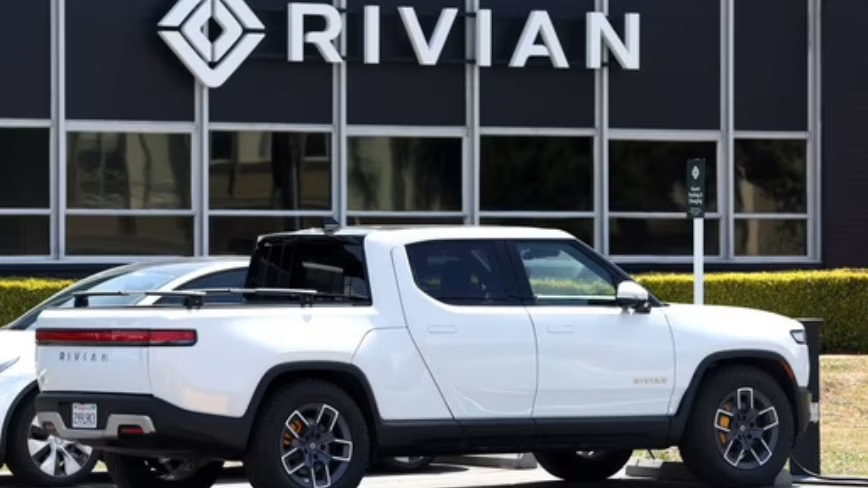
Key takeaway: Rivian has been hit with a class action lawsuit alleging it spent over five years promising hands-free, eyes-off self-driving capabilities on its first-gen R1T and R1S vehicles—features the plaintiffs claim are structurally impossible to deliver. The case underscores how critical it is to align public claims with the real-world constraints of on-premise AI infrastructure, especially in safety-critical domains like automotive.
The legal case
The lawsuit, filed in the US District Court for the Central District of California, contends that Rivian knowingly misled customers about the autonomous driving capabilities of its flagship vehicles. The company allegedly described a system capable of hands-free, eyes-off driving on highways and select roads, but the first-generation hardware lacks the necessary sensor suite and compute power for such advanced inference. The complaint argues the gap is not fixable via over-the-air updates, making the original representations false.
This dispute arrives at a time when public trust in self-driving technology is already under strain. Rivian is not the first automaker to face legal scrutiny over optimistic autonomy claims; the case echoes earlier controversies where the term “self-driving” itself became the subject of regulatory and legal debate. Yet here the core allegation is the permanent hardware limitation—a direct challenge to the on-board AI deployment decisions made during vehicle design.
On-vehicle AI architecture: constraints and complexity
Delivering Level 3 or higher autonomous driving requires a robust on-premise inference stack—essentially a rolling data center. Deep neural networks fuse high-resolution feeds from cameras, radars, lidars, and ultrasonic sensors, demanding real-time processing with latencies measured in milliseconds. Any delay can compromise safety.
The hardware constraints are familiar to those working on edge deployment: limited VRAM, compute throttled by thermal and power budgets, and the need for aggressive quantization (INT8 or lower) to run models on automotive system-on-chips. Dedicated neural processing units are often used, but their cost and availability heavily influence TCO. The Rivian lawsuit implies that the installed system fails to meet the redundancy and compute capacity required for true eyes-off driving, effectively capping the platform at a lower automation level than promised.
Why it matters
The Rivian case is more than a legal dispute: it is a barometer of technological realism in on-premise AI adoption. In an era where Large Language Models and edge inference are pushing boundaries, the automotive sector remains one of the harshest proving grounds. Here, every missed frame or delayed decision has direct safety implications. The saga illustrates what happens when marketing narratives outpace hardware readiness—a pitfall that can occur in any domain that relies on local inference.
For organizations evaluating self-hosted or edge architectures, the lesson is twofold. First, hardware specifications must be sized not only for current workloads but for future updates, or risk rapid functional obsolescence. Second, public claims—whether to customers or internal stakeholders—must be grounded on verifiable benchmarks run on production-identical platforms, especially in regulated or safety-critical settings. Failure to do so leads to litigation, eroded trust, and legal costs that can quietly inflate the overall TCO.
For those in healthcare, finance, or government where data sovereignty and GDPR compliance drive on-premise deployment, the Rivian story offers a parallel: the ability to run a model locally is not enough; the infrastructure must demonstrably meet all stated accuracy, latency, and robustness requirements. At AI-RADAR, this dimension is a recurring theme when weighing cloud versus on-premise solutions: total hardware control does not eliminate the risk of underestimating real operational needs.
Lessons for on-premise AI deployment
Rivian's experience encourages a more conservative, evidence-based approach to on-premise AI. Specifically, it is crucial to:
- Test inference on configurations identical to production, measuring p99 latency and sustained throughput under realistic load, not just in lab conditions.
- Adopt modular designs that allow cameras, compute units, and models to be upgraded independently without overhauling the entire stack.
- Communicate transparently about current capabilities and limits, clearly separating available features from roadmaps to avoid legal disputes and protect reputation.
These principles apply to less extreme domains as well, from NLP on embedded devices to factory machine vision. The difference between a successful AI project and a failed one often lies in aligning expectations with the physical reality of the systems involved.
Outlook
The class action against Rivian puts the entire tech industry on notice: AI promises must reckon with the limits of silicon and the complexity of distributed software. While much attention focuses on Large Language Models and cloud infrastructure, the true stress test for AI occurs at the edge, where local inference can make or break products—and, in the case of self-driving cars, human lives. The case will stand as a case study in how not to communicate on-premise AI capabilities, and a warning to take hardware choices seriously from the very first generation of a product.








💬 Comments (0)
🔒 Log in or register to comment on articles.
No comments yet. Be the first to comment!