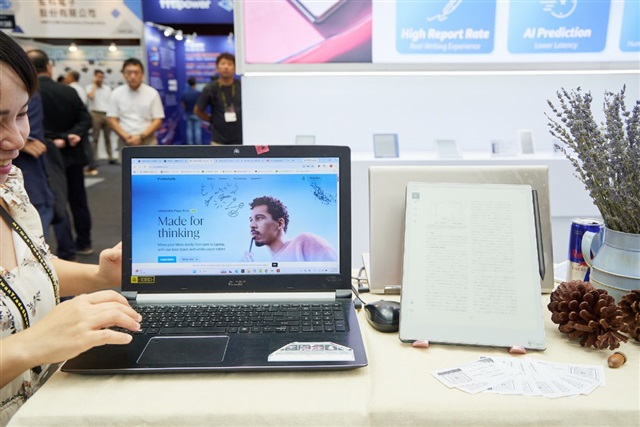
Displays are no longer just panels. With the rise of AI PCs, augmented reality glasses, and next-generation robots, screens are becoming the surface where local inference meets real-time interaction. Digitimes has highlighted how these three areas are reshaping display technology, but this shift demands a broader reading: it’s about the ability to process sensitive data directly on the device, bypassing the cloud.
Anyone designing on-premise AI infrastructure will see the connection. AI PCs with integrated NPUs, AR glasses that must merge graphics with the physical world at sub-20ms latency, collaborative robots analyzing video feeds and reacting instantly: all require high-resolution displays with high refresh rates and, critically, local compute power. The GPU or dedicated accelerator must sit physically close to the screen—otherwise network latency would ruin the experience. This changes requirements not just for panels (microLED, OLEDoS, low-persistence driving) but for the entire hardware chain, from on-device VRAM to serving frameworks optimized for edge contexts.
The classic trade-off applies: more local inference means less dependence on remote data centers, benefiting privacy (facial data and video streams stay local) and operational continuity (no risk of network lag or outages). On the other hand, it forces quantization of LLMs to run on hardware with limited resources. INT8 or FP16 formats become mandatory on devices that cannot host servers with hundreds of gigabytes of VRAM. And as these devices multiply (every robot, headset, AI-ready PC), the total cost of ownership shifts from a monthly cloud bill to upfront investment in local hardware and its maintenance.
In this landscape, display manufacturers aren’t just component suppliers; they must integrate visual pre-processing logic directly into the control circuitry. It’s a leap similar to when GPUs began incorporating video encoding engines. Today, an AR panel is more than light emission: it’s a system that talks to the inference runtime to reduce motion blur based on the scene predicted by the model.
From AI-RADAR’s perspective, those evaluating on-premise deployment of inference pipelines should watch this evolution. Displays are becoming intelligent endpoints that can shoulder part of the compute load, offloading central servers but introducing orchestration complexity. It’s no longer just about choosing a model or a quantization level: peripheral hardware actively contributes to reducing end-to-end latency, blurring the line between edge and on-premise.
The direction is clear. While data centers will continue to grind through large-scale training, inference is fragmenting across thousands of local nodes, each with its own screen, its GPU or NPU, and its optimized copy of the model. Displays are the visible face of a transformation rooted deep in compute circuits and serving frameworks—a change that impacts chip design as much as the architectural decisions of those building self-hosted AI infrastructure.







💬 Comments (0)
🔒 Log in or register to comment on articles.
No comments yet. Be the first to comment!