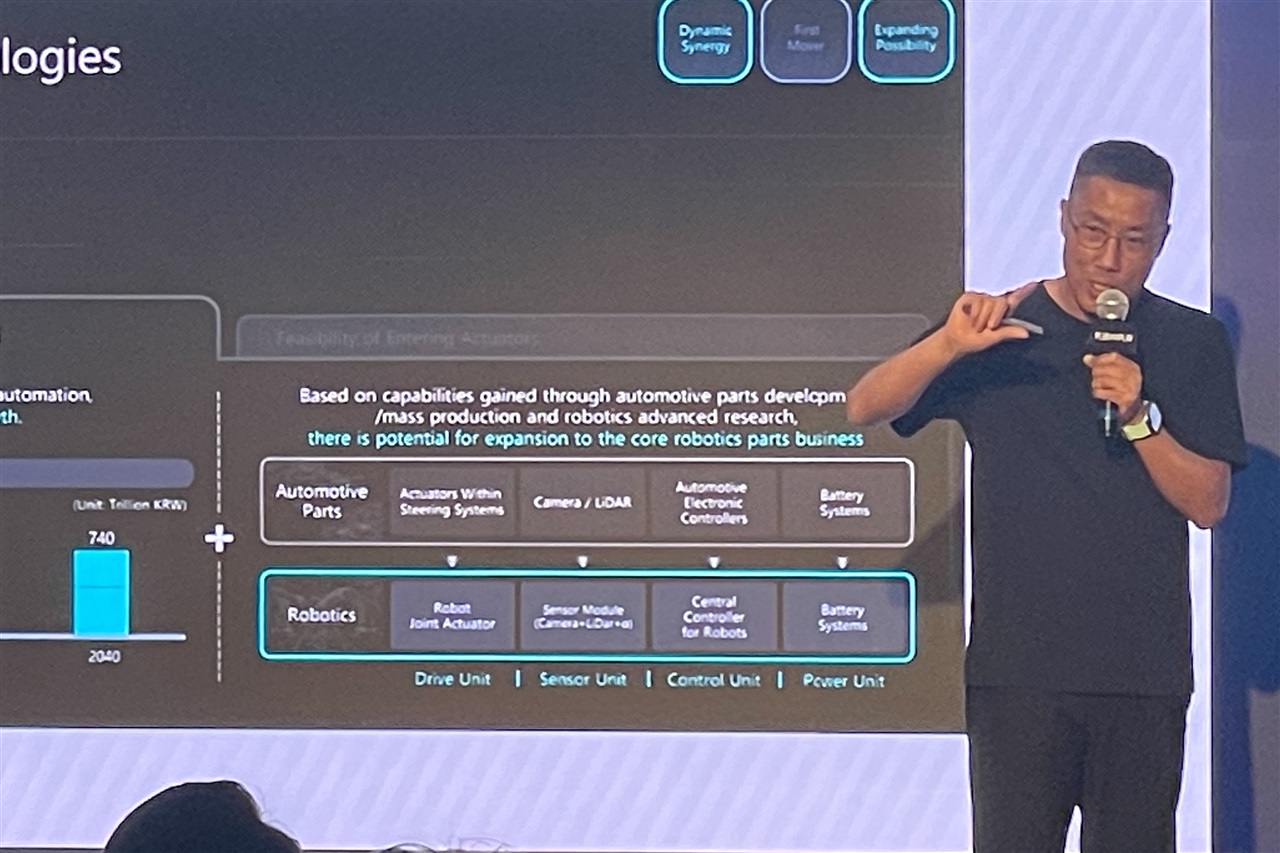
The Dawn of Humanoid Robotics in Automotive
Hyundai Mobis, a key player in the automotive supplier landscape, recently highlighted how humanoid robotics represents a generational opportunity for the sector. This perspective opens up unprecedented scenarios not only for production and logistics but also for human-machine interaction and the development of new vehicle functionalities. The integration of humanoid robots into industrial environments and, potentially, service contexts, requires a leap in artificial intelligence capabilities, laying the groundwork for a profound technological transformation.
Hyundai Mobis's vision underscores a broader trend: the convergence of advanced robotics and artificial intelligence. Humanoid robots, to operate autonomously and interact effectively with the environment and humans, require sophisticated AI systems. These include advanced perception capabilities (computer vision), motion planning, natural language understanding, and continuous learning, often powered by Large Language Models (LLMs) and other complex machine learning models.
Implications for AI Infrastructure and Hardware Requirements
The large-scale adoption of humanoid robotics entails significant infrastructure requirements for artificial intelligence. Running complex AI models, such as LLMs for context understanding and response generation, or vision models for navigation and manipulation, demands substantial computational power. This translates into the need for specialized hardware, particularly GPUs with ample VRAM and high throughput capabilities, both for training phases and, crucially, for real-time inference.
Low latency is a critical factor for robotics. Decisions must be made and actions executed with minimal response times to ensure safety and efficiency. This drives the need for AI processing solutions that are as close as possible to the point of use, often implying on-premise or edge deployments. Managing complex data pipelines, ranging from robot sensors to AI processing servers and back, requires a robust and optimized network infrastructure for intensive workloads.
Data Sovereignty, TCO, and the Role of On-Premise Deployment
For automotive companies, managing data generated by humanoid robots raises fundamental questions of sovereignty and security. Operational data, information on production processes, and, in the future, sensitive data on user interaction, demand stringent control. On-premise deployments offer greater control over data localization, facilitating compliance with regulations like GDPR and ensuring security in air-gapped or highly regulated environments.
From an economic perspective, evaluating the Total Cost of Ownership (TCO) is crucial. While the initial investment (CapEx) for on-premise infrastructure might be higher compared to cloud solutions, long-term operational costs (OpEx) for consistent and predictable AI workloads can prove more advantageous. The ability to optimize hardware utilization, manage software licenses, and have direct control over the computing environment contributes to better overall cost management. For those evaluating on-premise deployments, AI-RADAR offers analytical frameworks on /llm-onpremise to assess the trade-offs between costs, performance, and control.
Future Prospects and Trade-offs to Consider
The opportunity presented by humanoid robotics is undeniable, but its full realization will depend on companies' ability to address technical and strategic complexities. Integrating advanced LLMs and vision models into robots will require not only powerful hardware but also robust software frameworks for model orchestration and management. The choice between on-premise, cloud, or hybrid deployment will become a strategic decision, influenced by factors such as required latency, data sensitivity, scalability needs, and desired TCO.
The automotive sector stands at a crossroads: fully embracing AI and humanoid robotics means investing in infrastructures capable of supporting these emerging technologies. The ability to balance innovation, security, and economic sustainability will be key to capitalizing on this generational opportunity, transforming technological challenges into lasting competitive advantages.





💬 Comments (0)
🔒 Log in or register to comment on articles.
No comments yet. Be the first to comment!