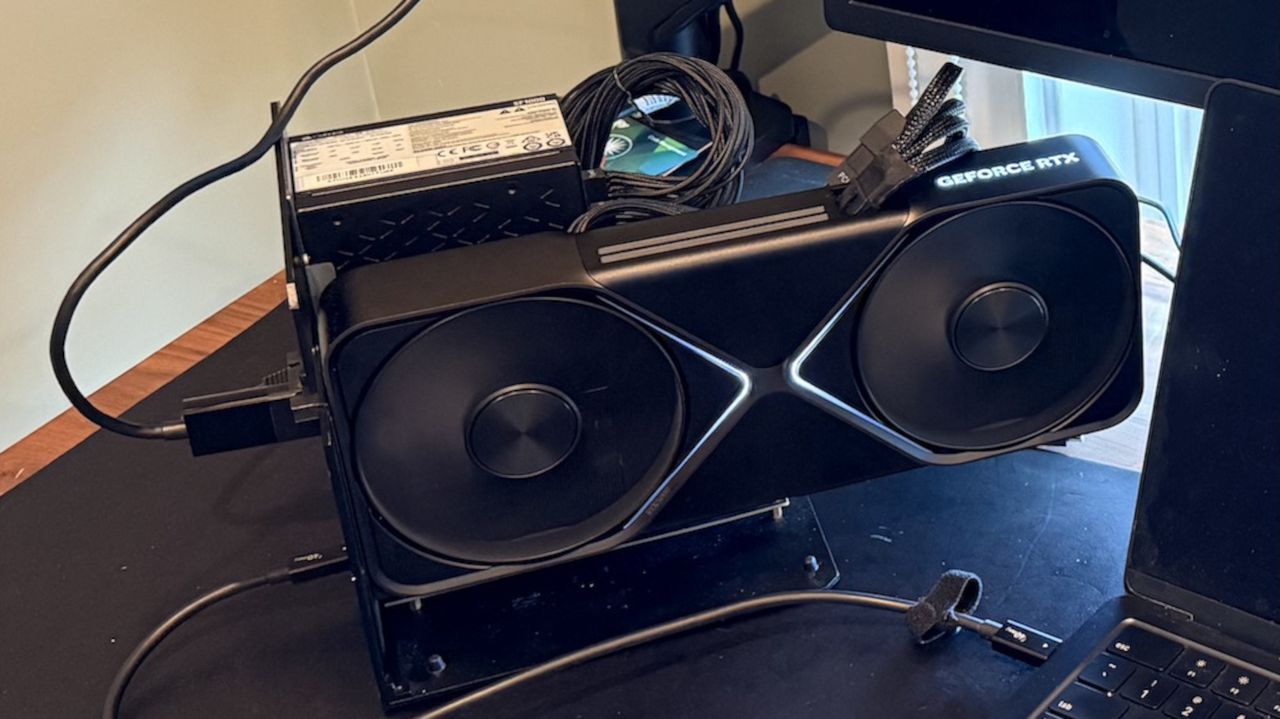
Extending Computational Capabilities with eGPUs
A recent experiment has highlighted the remarkable computational capabilities achievable by combining a high-end GPU with a mobile platform. Specifically, an RTX 5090 was connected to an M-series MacBook using an eGPU dock. This configuration allowed the system to run a notoriously demanding title like Cyberpunk 2077 at over 100 FPS, with maximum graphics settings and frame generation technology enabled.
This result, while stemming from a gaming context, offers significant insights for the world of intensive workloads, including those related to Large Language Models (LLM). The ability to pair specialized computing hardware with existing client systems or workstations opens new perspectives for infrastructure architects and CTOs evaluating on-premise deployment strategies.
Technical Details and Implications for AI
The core of this configuration lies in the use of an eGPU dock, which acts as a bridge between the powerful external GPU and the host system. Typically, these solutions leverage high-speed interfaces like Thunderbolt to ensure sufficient throughput for data transfer between the GPU and the MacBook's CPU. The RTX 5090, while not yet on the market, represents the next generation of NVIDIA graphics cards, promising high performance and significant VRAM, crucial elements for LLM Inference and training.
For AI workloads, the availability of VRAM and GPU computational power are determining factors. Complex models require large amounts of memory to be loaded and processed efficiently. The eGPU approach allows overcoming the inherent limitations of integrated GPUs in portable systems or less powerful desktops, providing the dedicated hardware necessary for operations such as Fine-tuning smaller models or large-scale Inference. However, it is essential to consider the bandwidth and latency constraints imposed by the external connection compared to a GPU installed directly in an internal PCIe slot.
On-Premise Deployment Scenarios and TCO
The flexibility offered by eGPUs can be particularly appealing for companies adopting on-premise or hybrid deployment strategies. Instead of investing in dedicated servers or expensive cloud infrastructure for every AI computing need, a development team could leverage existing workstations, such as a MacBook, and augment them with an eGPU for specific projects. This model can reduce the initial Total Cost of Ownership (TCO), allowing for a more targeted investment in pure computing hardware.
Furthermore, for organizations prioritizing data sovereignty and compliance, local processing via eGPU ensures that sensitive data does not leave the company's controlled environment. This is a crucial aspect for sectors such as finance or healthcare, where privacy regulations are stringent. The ability to create robust and air-gapped development and testing environments, if necessary, becomes more accessible.
Future Prospects and Trade-offs
The evolution of external interfaces and GPUs will continue to improve eGPU performance, making them increasingly viable options for a wide range of applications. However, it is essential to carefully evaluate the trade-offs. While they offer flexibility and potentially lower TCO for specific workloads, they might not match the throughput and latency of a bare metal infrastructure or a cluster of GPUs interconnected via NVLink.
For those evaluating on-premise LLM deployments, AI-RADAR offers analytical frameworks on /llm-onpremise to assess these trade-offs, considering factors such as scalability, VRAM requirements, and throughput needs. The choice of the most suitable hardware configuration will always depend on the specific workload requirements and the organization's strategic objectives.







💬 Comments (0)
🔒 Log in or register to comment on articles.
No comments yet. Be the first to comment!