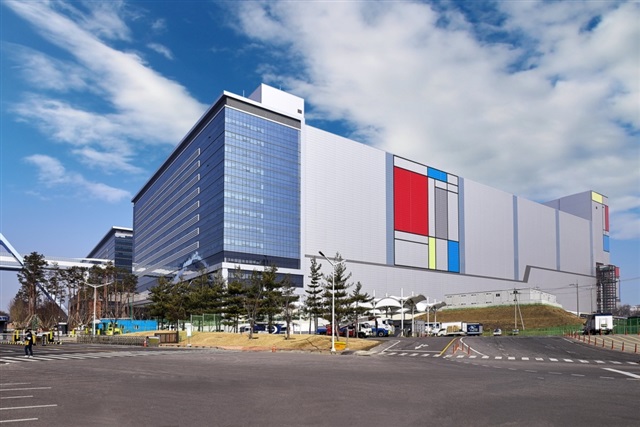
Samsung's "AI Factory" Initiative
Samsung, one of the global electronics giants, is reportedly exploring new frontiers in integrating artificial intelligence into its production processes. The company is said to be planning to open access to its factory data (known as "fab data") to a selected network of suppliers. This strategy is part of a broader "AI factory" vision, a concept that aims to revolutionize efficiency and innovation through the pervasive application of artificial intelligence algorithms.
The primary goal of this initiative is twofold: on one hand, to improve collaboration and transparency across the entire supply chain; on the other, to leverage AI to optimize every phase, from design to production, and logistics. Sharing detailed data with suppliers could enable more accurate predictive analysis, more efficient inventory management, and a reduction in development and production times.
Implications for Data Sovereignty and Management
Opening "fab data" to suppliers, while promising in terms of efficiency, raises significant questions regarding data sovereignty and security. Information related to production processes, proprietary designs, and operational metrics are among the most sensitive for a manufacturing company. Their sharing requires a robust security architecture and stringent access protocols to prevent breaches or misuse.
For companies operating with such critical data, the choice between an on-premise deployment and cloud solutions becomes fundamental. A self-hosted infrastructure offers direct and granular control over data, which is essential for meeting stringent compliance requirements and maintaining sovereignty over information. This approach allows for the definition of customized access policies and the implementation of tailored physical and logical security solutions, reducing reliance on third parties for managing strategic assets.
Infrastructure for an On-Premise "AI Factory"
The vision of an "AI factory" implies enormous processing and data management capabilities. To support real-time analysis, machine learning models for quality control, predictive maintenance, and workflow optimization, considerable hardware resources are necessary. This includes servers equipped with high-performance GPUs, such as NVIDIA A100 or H100 series, with ample VRAM for training and inference of Large Language Models or complex computer vision models.
An on-premise deployment for an "AI factory" requires careful infrastructure planning, from high-speed storage capacity for raw production data to low-latency networking for communication between sensors and processing systems. Evaluating the TCO (Total Cost of Ownership) becomes crucial, considering not only the initial investment in hardware and software but also operational costs related to energy, cooling, and maintenance. For those evaluating on-premise deployments, AI-RADAR offers analytical frameworks on /llm-onpremise to assess trade-offs between performance, costs, and control.
Future Prospects and Collaborative Challenges
Samsung's initiative highlights a growing trend in the manufacturing sector: the adoption of AI not just to automate tasks, but to create smarter collaborative ecosystems. Opening data to suppliers could act as a catalyst for joint innovation, allowing partners to develop solutions and components that are more aligned with Samsung's specific needs.
However, the challenge lies in balancing the benefits of collaboration with the need to protect intellectual property and data security. Implementing secure data sharing platforms, adopting industry standards for interoperability, and defining clear contractual agreements will be fundamental steps for the success of this vision. Samsung's "AI factory," with its emphasis on data sharing, could define new paradigms for Industry 4.0, prompting other companies to reconsider their deployment and data management strategies in an AI-dominated era.







💬 Comments (0)
🔒 Log in or register to comment on articles.
No comments yet. Be the first to comment!