A Historic Milestone for Samsung and the Semiconductor Sector
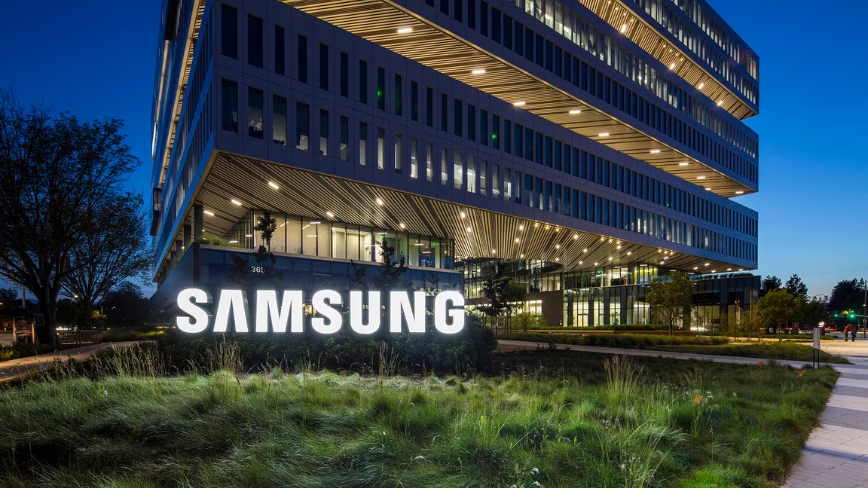
Samsung Electronics recently surpassed the $1 trillion market capitalization threshold, joining TSMC in this exclusive club of tech giants. This achievement underscores the growing influence and strategic value of semiconductor manufacturers in the current global technological landscape. Samsung's stock has seen exceptional growth, quadrupling its value in just one year, a clear indicator of investor confidence in its central role.
Samsung's success is not an isolated event but reflects a broader trend reshaping the market. The KOSPI index, South Korea's main stock market indicator, broke 7,000 points for the first time, with the two largest Korean chipmakers now accounting for 42% of the entire index. This data highlights the Korean economy's reliance on the semiconductor sector, particularly the demand for essential components for artificial intelligence.
The AI Memory "Supercycle" and Its Implications
The primary driver behind this rapid growth is the so-called "supercycle" in AI memory. The demand for high-performance memory solutions, such as VRAM and HBM (High Bandwidth Memory), has exploded with the advancement of Large Language Models (LLM) and artificial intelligence applications. These components are crucial for training and Inference of complex models, which require enormous amounts of data and processing capabilities.
According to Samsung's own forecast, this supercycle has not yet reached its peak. This suggests that the AI memory market will continue to expand, bringing both opportunities and challenges for the entire supply chain and for companies that depend on these components. The increasing market capitalization of memory manufacturers is a direct signal of demand pressure and the strategic importance of these technologies.
Impact on On-Premise Deployments and TCO Management
For organizations evaluating or already implementing on-premise LLM solutions, the dynamics of the AI memory market have a direct impact. The availability and cost of GPUs, particularly those equipped with high amounts of VRAM, are critical factors for the success of self-hosted deployments. A rapidly growing market, like the current one, can lead to price fluctuations and potential supply constraints, affecting the Total Cost of Ownership (TCO) of AI infrastructures.
The choice between on-premise deployment and cloud solutions for AI/LLM workloads is increasingly complex. While on-premise offers advantages in terms of data sovereignty, control, and security for air-gapped environments, it also requires careful planning of hardware investments. Understanding semiconductor market trends, such as the AI memory supercycle, becomes essential for accurately estimating initial CapEx and long-term operational costs, ensuring that the infrastructure can support Inference and fine-tuning needs.
Future Outlook and Strategies for AI Infrastructure
Samsung's forecast that the supercycle has not yet peaked suggests a prolonged period of strong demand for AI memory. This scenario compels companies to adopt proactive strategies for managing their AI infrastructure. Diversification of suppliers, long-term planning for hardware purchases, and optimization of existing resource utilization become priorities.
For CTOs, DevOps leads, and infrastructure architects, it is essential to monitor the evolution of the semiconductor market. Deployment decisions must consider not only current technical specifications but also market projections that can influence the scalability and economic sustainability of self-hosted AI solutions. AI-RADAR offers analytical frameworks on /llm-onpremise to evaluate these trade-offs, providing tools to navigate a rapidly evolving market and make informed decisions about on-premise deployments.






💬 Comments (0)
🔒 Log in or register to comment on articles.
No comments yet. Be the first to comment!