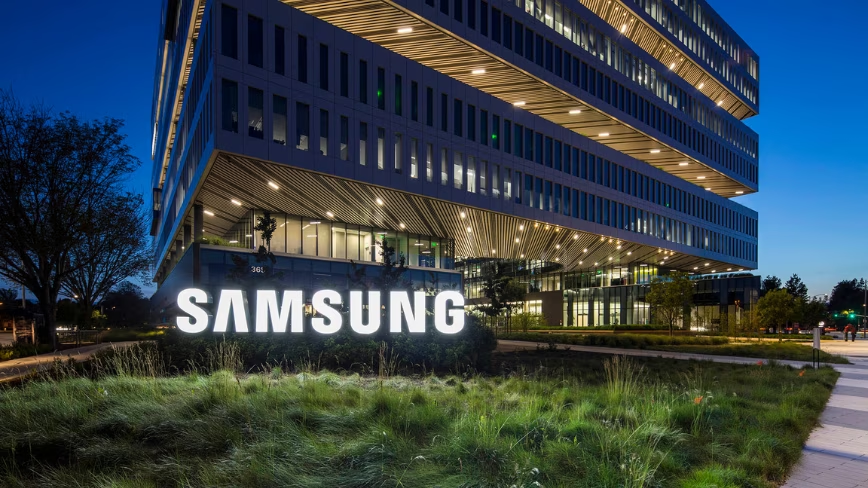
A Strategic Investment in Silicon
Samsung Electronics has confirmed an investment of 39 trillion dong, approximately $1.5 billion, for the establishment of a semiconductor testing plant in Vietnam. Construction is already underway within an industrial park situated about 60 kilometers north of the capital, Hanoi. Operations are scheduled to commence in November 2027. This project represents a significant step for the company, as it will be Samsung's first facility entirely dedicated to chip testing in the country.
Expanding testing capabilities is crucial in the current technological landscape. With the increasing complexity of modern chips, particularly those intended for intensive workloads such as LLMs and artificial intelligence, the verification and validation phase becomes ever more critical. Rigorous testing ensures the quality, reliability, and performance of silicon before its market release, reducing defect rates and optimizing the overall efficiency of the supply chain.
The Role of Semiconductor Testing in the Tech Ecosystem
The semiconductor testing process is a fundamental, often underestimated, yet essential component of chip manufacturing. It involves performing a series of electrical and functional checks to ensure that each chip meets design specifications and is free of defects. This includes signal integrity tests, power consumption, temperature tolerance, and for more advanced chips, performance verification under high-load scenarios.
For companies developing AI and LLM solutions, the quality of the underlying silicon directly impacts the performance and reliability of their systems. A faulty chip can lead to outages, computational errors, and ultimately increase TCO due to maintenance and replacements. Samsung's investment in a dedicated facility underscores the importance of high standards at this stage, helping to ensure that hardware components, from GPUs to NPUs, are ready to meet the most demanding computational challenges.
Implications for the Global Supply Chain
The opening of a new testing facility in Vietnam reflects a broader trend in the semiconductor industry: the geographical diversification of the supply chain. Geopolitical tensions and disruptions related to global events have prompted many companies to reduce reliance on single regions, seeking to build greater resilience. Vietnam, with its skilled workforce and competitive operating costs, is emerging as a strategic hub for the production and testing of electronic components.
This diversification strategy is particularly relevant for companies aiming for data sovereignty and on-premise deployments. A more robust and distributed supply chain can help mitigate risks related to the availability and security of essential hardware components. Although a testing facility is not directly a data center, its existence is an integral part of the global infrastructure that supports the development and deployment of critical technologies, including systems for LLM inference and training.
Future Prospects and Vietnam's Role in High-Tech
Samsung's investment further strengthens Vietnam's position as a key player in the global electronics industry. Over the years, the country has attracted significant investments from tech giants, becoming a center for the assembly and production of various devices. The addition of a semiconductor testing facility of this magnitude elevates Vietnam's technological profile, shifting a portion of the value chain towards higher-complexity activities.
For the tech sector, and particularly for those involved in AI infrastructure, the availability of tested and reliable components is a prerequisite. This type of upstream investment in the supply chain indirectly contributes to the stability and predictability of hardware costs, a crucial factor for TCO planning in large-scale deployments. Samsung's commitment in Vietnam highlights a long-term vision to support the global demand for high-quality semiconductors.







💬 Comments (0)
🔒 Log in or register to comment on articles.
No comments yet. Be the first to comment!