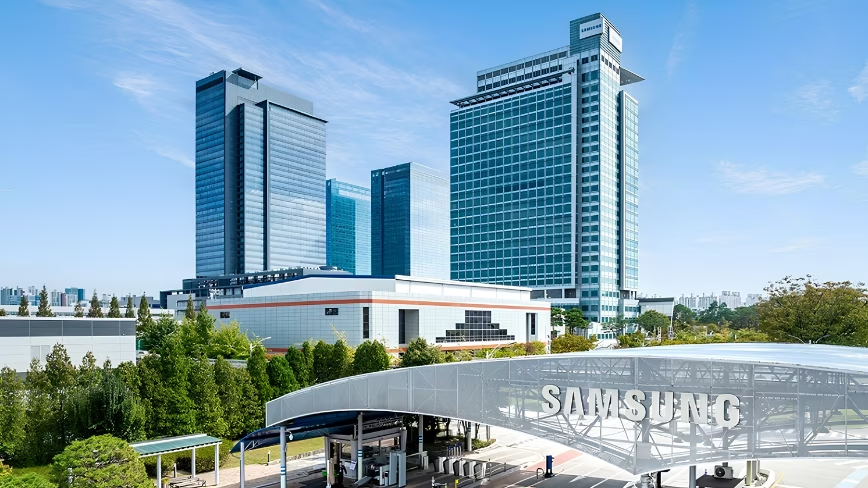
The figure resets every previous reference. Samsung Electronics reported an operating profit of about 89.4 trillion won ($58.4 billion) for the second quarter, a 19-fold increase over the same period last year and, by most counts, the largest quarterly operating profit ever achieved by a technology company. It is the third consecutive record quarter and beats analyst estimates by more than 5 trillion won.
There is no mystery behind the result: artificial intelligence memory demand is driving the growth, in a market where compute capacity is no longer the only measure. The surge in orders for HBM (High Bandwidth Memory) and high-density data center memory tells a story that goes far beyond Samsung's balance sheet. It indicates that the AI industry has an insatiable appetite for bandwidth, and that this appetite is creating a deep asymmetry between those who produce memory and those who consume it.
Those following the evolution of on-premise LLMs know that bottlenecks are not just about TOPS or teraflops. They are about available VRAM and the speed at which data moves between memory and compute units. The fact that a single memory maker can post such a surplus signals a dangerous concentration in the supply chain. Samsung, together with SK hynix and a few others, controls almost all HBM production. That memory is essential for the most powerful GPUs (from NVIDIA H100s to upcoming generations), which in turn fuel large-scale training and inference. When an organization evaluates an on-premise deployment to keep its data away from cloud providers, the availability and cost of these boards become critical variables. And the memory variable is now more critical than ever.
This goes beyond pricing. A market where HBM demand outstrips supply for consecutive quarters — as Samsung's record profit suggests — shifts bargaining power toward chip makers. Companies designing on-premise infrastructure risk being sidelined by the large hyperscalers, who book entire production runs months in advance. In TCO terms, memory cost is eating up a growing share, while the promised savings of self-hosting over the cloud weaken if the necessary hardware becomes scarce or prohibitively expensive. Data sovereignty, a pillar of on-premise strategies, can also become a privilege for a few: only organizations with sufficient negotiating clout and budgets will be able to maintain in-house training or inference suites, with full jurisdiction over their data.
The ripple effect on the ecosystem is twofold. On one side, the huge profitability pushes Samsung and its competitors to invest in new fabs, expanding production capacity over the medium term. On the other, the signal will accelerate research into alternative architectures that reduce dependence on HBM: smaller models, aggressive quantization, offloading techniques, and new chip designs aimed at minimizing memory-bandwidth needs. Those developing frameworks for on-premise LLMs will increasingly have to adapt to scenarios where VRAM is the absolute constraint.
Ultimately, Samsung's stellar quarter is not just a financial headline. It is a structural indicator: memory cost is eating up a growing slice of the value generated by AI, and this is shifting the calculus for those who want to retain control of their own stack. It is no longer just a matter of having the best models, but of being able to afford them.





💬 Comments (0)
🔒 Log in or register to comment on articles.
No comments yet. Be the first to comment!