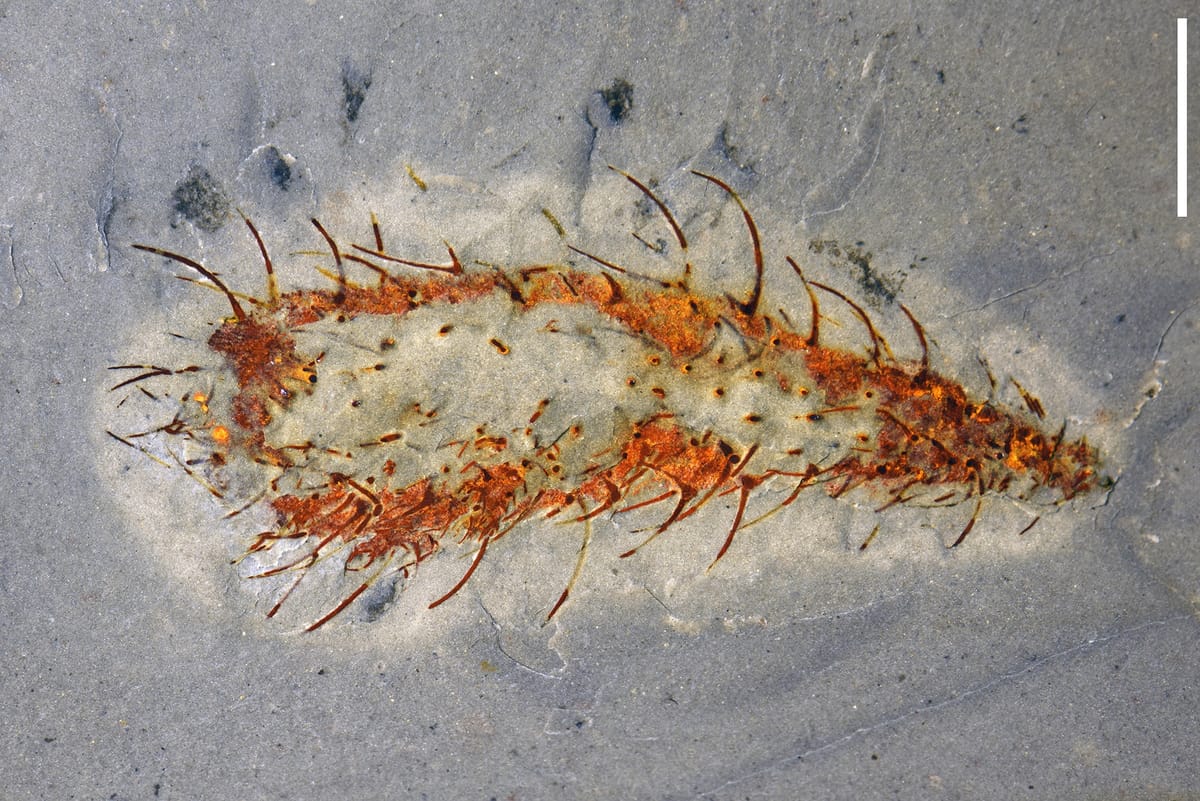
Blast from the Cambrian past
Paleontologists have discovered the fossilized remains of a 512-million-year-old ecosystem in China, dating back to the Cambrian period. The discovery, in Huayuan County, reveals dozens of previously unknown species.
Between 2021 and 2024, thousands of specimens were unearthed, with remarkable taxonomic richness: 153 animal species, of which 59% are new. Many of the same animals have been found at other Cambrian sites, suggesting widespread dispersal across the ancient superocean.
The fossils have been exceptionally preserved in mudstone, preserving soft tissues such as tentacles, guts, and a nearly complete nervous system in one arthropod. The ecosystem dates back to a period after the Cambrian explosion and a mass extinction event called the Sinsk event.
Among the most fascinating creatures is Herpetogaster, an enigmatic organism with tubes and tentacles, of which over 100 specimens have been found.
Microraptor: the original early bird
Another study focuses on Microraptor, a dinosaur from the Early Cretaceous period with four wings. Researchers have modeled its flight dynamics, demonstrating the interactions between the forewings and hindwings that helped this airborne predator.
Grub’s up
Insects could play an important role in future food security. More than 2,000 insect species are considered safe for human consumption, offering nutrients such as proteins, lipids, minerals, and vitamins. Insect-based food production presents environmental advantages, including lower water consumption and reduced greenhouse gas emissions.
A glimpse of alien auroras
A team of researchers may have detected radio signals from distant star systems, potentially related to solar storm activity and auroras on other planets. Further studies are needed to confirm the origin of these radio emissions.







💬 Comments (0)
🔒 Log in or register to comment on articles.
No comments yet. Be the first to comment!