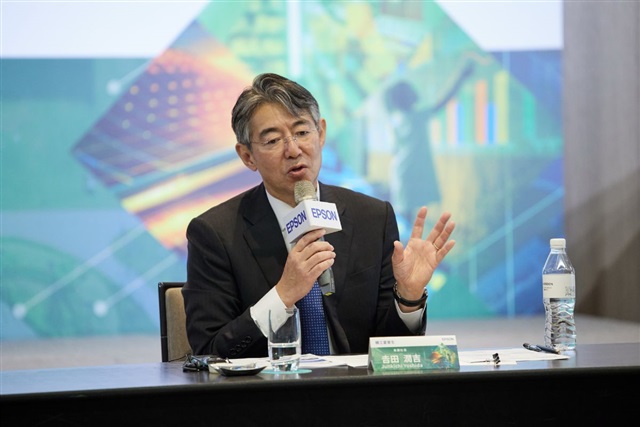
Seiko Epson's Strategic Vision
Seiko Epson, a company renowned for its technological innovations, recently announced, through its president Junkichi Yoshida, a long-term vision focused on sustainable growth. This statement underscores the company's commitment to development that balances economic, environmental, and social needs—an increasingly relevant theme in the global technology landscape.
The sustainable growth strategy is not limited to ecological impact alone; it also encompasses operational resilience and adaptability to a continuously evolving market. For large enterprises and technology decision-makers, such an approach implies a deep reflection on the infrastructural foundations that support innovation and expansion.
Sustainability and IT Infrastructure: A Crucial Link
In the current context, "sustainable growth" for a technology company often translates into strategic choices regarding IT infrastructure. The exponential increase in computational workloads, particularly those related to Large Language Models (LLM) and artificial intelligence, poses significant challenges in terms of energy consumption, heat management, and operational costs. An infrastructure's ability to support these demands efficiently and controllably is fundamental for long-term sustainability.
Companies must carefully evaluate the Total Cost of Ownership (TCO) of their solutions, comparing the initial capital expenditure (CapEx) of an on-premise or bare metal deployment with the recurring operational expenditure (OpEx) of cloud services. Factors such as the energy efficiency of servers and GPUs (e.g., the VRAM and power consumption of A100 or H100 cards), network latency and throughput, and the ability to scale controllably, are key elements in this analysis.
Implications for On-Premise Deployments and Data Sovereignty
The pursuit of sustainable growth drives many organizations to reconsider their deployment models. For sectors with stringent compliance requirements or those needing high data sovereignty, self-hosted or air-gapped solutions become strategic options. These choices allow for granular control over the environment, security, and data location—aspects that directly contribute to operational sustainability and risk reduction.
However, an on-premise deployment requires significant internal expertise for hardware and software management and optimization. The choice between a fully local infrastructure, a hybrid model, or a massive cloud adoption involves complex trade-offs in terms of flexibility, cost, and control. For those evaluating on-premise deployments, analytical frameworks, such as those offered by AI-RADAR on /llm-onpremise, help weigh these constraints and make informed decisions.
Future Prospects and Strategic Decisions
Seiko Epson's vision for sustainable growth reflects a broader industry trend where long-term planning is essential. For CTOs, DevOps leads, and infrastructure architects, this means not only selecting the most performant technology but also the one that guarantees the greatest resilience, efficiency, and control over time. Today's infrastructure decisions, whether choosing between different GPU architectures for LLM inference or defining a deployment pipeline, will directly impact a company's ability to sustain its growth and innovation over the next decade.
In an era of rapid technological evolution, sustainability is no longer optional but a strategic imperative that permeates every decision-making level, from silicio selection to data management.





💬 Comments (0)
🔒 Log in or register to comment on articles.
No comments yet. Be the first to comment!