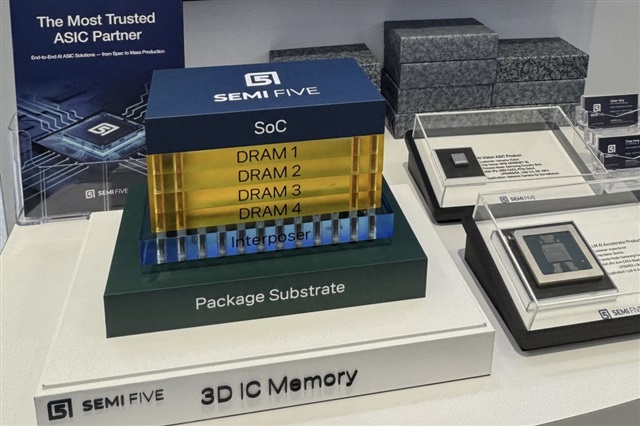
SEMIFIVE has started producing its HyperAccel chips on Samsung's 4-nanometer node, at a time when production capacity on that process is tightening. The company, which offers custom ASICs and accelerators dedicated to LLMs, is positioning itself at a precise point in the supply chain: it does not sell general-purpose GPUs, but silicon designed for specific inference workloads.
The news should not be read only as a production milestone. It is a structural signal for anyone managing AI infrastructure. The market for LLM accelerators is beginning to split in two directions. On one side remain GPUs, with their mature software ecosystem and programming flexibility. On the other side, custom ASICs are emerging, promising lower power consumption and potentially lower cost per token on stable workloads. In a context of limited production capacity, the choice of an advanced node like Samsung's 4nm indicates that specialized silicon makers must also compete for wafers with chips for smartphones, CPUs, and high-end GPUs.
For those evaluating self-hosted infrastructure, the issue is not only technical. A custom accelerator can reduce TCO when the workload is predictable: the model does not change often, inference requests have known latency and batch characteristics, and hardware optimization can be pushed to levels that a general-purpose chip rarely reaches. But the trade-off is significant: an ASIC is less adaptable to new models, new quantization schemes, or fine-tuning needs. In a landscape where LLMs evolve quickly, locking hardware into a fixed architecture can become a hidden cost.
The tightening of capacity on Samsung's 4nm node introduces a second layer of pressure. Suppliers without guaranteed volumes risk longer delivery times or having to renegotiate wafer allocations. This penalizes smaller projects and can favor those with established foundry relationships or orders large enough to justify an ASIC investment. The medium-term consequence is likely consolidation: not every team that wants a custom accelerator will be able to bring it to production without relying on an industrial partner.
The SEMIFIVE case also matters for those who will not buy these chips. It signals that silicon dedicated to LLMs is moving out of the experimental phase and into industrial supply logic, where production capacity availability counts as much as design quality. For those planning on-premise deployments, the gradual arrival of ASIC alternatives alongside GPUs shifts attention from acquisition cost alone to operational sustainability: power consumption, serving software, framework compatibility, and platform lifespan. For those evaluating on-premise deployments, AI-RADAR offers analytical frameworks on /llm-onpremise to compare these trade-offs. This is not a promise of universal performance, but a change of incentives for the entire supply chain.





💬 Comments (0)
🔒 Log in or register to comment on articles.
No comments yet. Be the first to comment!