A Chinese Capital Injection for Serbian Technology
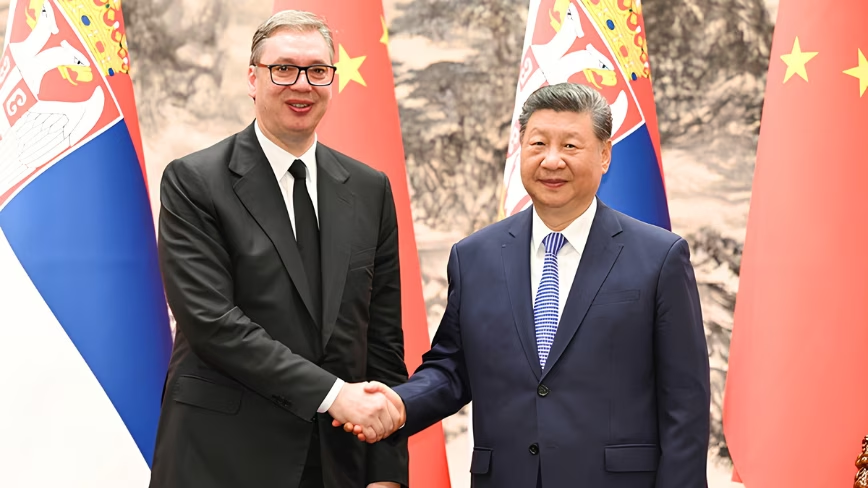
Serbia is poised to receive a significant economic and technological boost through a $1.1 billion investment from China. This financial package is specifically directed towards key sectors such as artificial intelligence (AI), robotics, and electric vehicles (EVs), highlighting Beijing's clear strategy to strengthen its presence and technological influence in the Balkan region. The announcement of this agreement occurred during a period of considerable internal political unrest for Serbia.
Indeed, the Chinese investment was formalized just four days after a massive protest saw tens of thousands of Serbian citizens take to the streets of Belgrade. Police estimates indicate approximately 34,300 people demonstrated, demanding early elections and greater political accountability. This context adds a complex dimension to the agreement, raising questions about the internal and external dynamics influencing the country's strategic decisions.
Implications for LLM Deployment and Data Sovereignty
While the investment in AI and robotics does not specify details on Large Language Models (LLMs) or deployment infrastructure, it necessarily implies the development of computational and data management capabilities. For a country like Serbia, a capital injection into these sectors can mean an opportunity to build robust technological infrastructures, potentially oriented towards self-hosted and on-premise solutions. This approach is crucial for ensuring data sovereignty and control over AI operations, fundamental aspects for companies and institutions handling sensitive information.
Choosing an on-premise deployment for AI workloads, including Large Language Models, offers advantages in terms of security, compliance, and long-term Total Cost of Ownership (TCO), despite a higher initial CapEx. The ability to keep data within national borders and have full control over hardware and software is a decisive factor for many organizations. This type of investment can therefore foster the creation of local data centers and the acquisition of specific hardware, such as high-performance GPUs, essential for inference and fine-tuning of complex models.
The Geopolitical Context and European Response
The agreement between China and Serbia fits into a broader geopolitical framework, where China continues to expand its economic and technological influence in Europe, often through direct investments in infrastructure and strategic sectors. The timing of the announcement, close to internal protests, could be interpreted as an attempt to strengthen the stability of the Serbian government or, at least, to capitalize on a moment of political vulnerability.
Brussels' reaction to these developments has so far been absent or, at least, incoherent. The European Union faces the challenge of formulating an effective strategy to counter China's advance in the Balkans and other candidate or partner countries, especially when it comes to high-tech sectors like AI and robotics. The lack of a clear response from the EU could leave room for further bilateral agreements that might alter regional geopolitical balances and future technological directions.
Future Prospects and Strategic Considerations
For Serbia, the Chinese investment represents an opportunity to accelerate technological development and diversify its economy. However, it also entails the need to balance economic benefits with long-term implications in terms of technological dependence and geopolitical alignment. Decisions regarding technological infrastructure, particularly for AI, will significantly impact the country's ability to maintain control over its data and innovation.
For Serbian companies and institutions, the availability of new capital for AI and robotics raises crucial questions about deployment. The choice between cloud and self-hosted solutions for Large Language Models workloads and other AI systems will require careful analysis of TCO, security requirements, and regulatory compliance. AI-RADAR offers analytical frameworks on /llm-onpremise to evaluate these trade-offs, providing tools for informed decisions that prioritize data sovereignty and operational control.










💬 Comments (0)
🔒 Log in or register to comment on articles.
No comments yet. Be the first to comment!