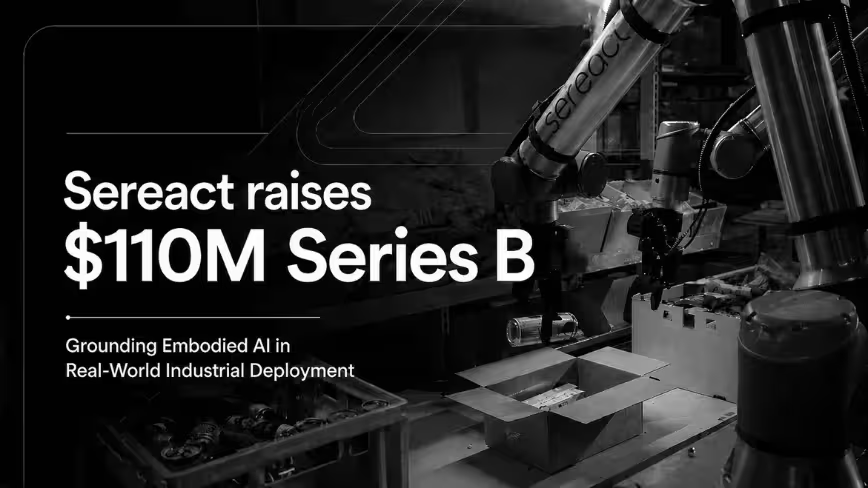
Sereact Raises $110 Million for AI Robotics with Simulation Models
Sereact, a Stuttgart-based AI robotics software company, has announced the closing of a significant Series B funding round, raising $110 million. This investment represents a remarkable acceleration for the company, which had previously secured €25 million in a Series A round just 15 months ago. The new capital is more than four times the amount of the previous funding, underscoring the rapid growth and market interest in its solutions.
The round was led by Headline, with participation from new prominent investors including Bullhound Capital, Felix Capital, and Daphni. While the specific valuation of the company was not disclosed, the scale of the funding highlights strong confidence in Sereact's potential to innovate in the autonomous robotics sector.
The Evolution of Vision Language Action Models
At the core of Sereact's technological offering are its "vision language action models." These models represent a crucial evolution in artificial intelligence applied to robotics, enabling autonomous systems to interpret the surrounding world through vision, understand complex instructions via natural language, and translate these understandings into concrete physical actions. A robot's ability to process visual and linguistic information to make operational decisions is fundamental for advanced automation in industrial and logistics environments.
The Series B funding will be used for an ambitious goal: to develop robots capable of simulating the consequences of their actions before executing them. This functionality is vital for improving the safety, reliability, and efficiency of robotic systems, especially in complex and dynamic contexts where errors or unforeseen events can incur high costs. Predictive simulation allows robots to "reason" about the potential repercussions of their choices, optimizing paths and operations in advance.
Impact on Industrial Automation and Deployment
The adoption of Sereact's technology is already a reality in key sectors. Its models are operational with high-profile clients such as BMW, Daimler Truck, and several other companies in the logistics sector. This demonstrates the maturity and effectiveness of the company's solutions in real industrial contexts, where precision and reliability are non-negotiable requirements. The integration of AI robotics in these environments can lead to significant improvements in operational efficiency, error reduction, and process optimization.
For companies evaluating the implementation of such systems, on-premise or hybrid environment deployment is often a primary consideration. Factors such as data sovereignty, critical latency for real-time operations, and the need to operate in air-gapped environments for security or compliance reasons make self-hosted solutions particularly attractive. The ability to manage AI workloads locally can also influence the overall TCO, balancing initial capital expenditures with long-term benefits in terms of control and performance. AI-RADAR, for instance, offers analytical frameworks on /llm-onpremise to evaluate the trade-offs between different deployment strategies.
Future Prospects for Autonomous Robotics
The investment in Sereact not only validates its technological approach but also reflects a broader trend towards increasingly autonomous and intelligent robotic systems. A robot's ability to anticipate and simulate the consequences of its actions marks a significant step towards more sophisticated robotics less dependent on direct human intervention. This opens new frontiers for automation in sectors ranging from manufacturing to logistics, and even more complex and unpredictable scenarios.
As Large Language Models (LLM) and multimodal models continue to evolve, their integration with robotics promises to unlock unprecedented levels of intelligence and adaptability. Challenges remain, particularly concerning efficient inference and deployment on edge or on-premise hardware, but the progress of companies like Sereact indicates a future where robots not only perform tasks but understand and plan them with near-human awareness.





💬 Comments (0)
🔒 Log in or register to comment on articles.
No comments yet. Be the first to comment!