
The AI Infrastructure Market Drives Shenmao's Growth
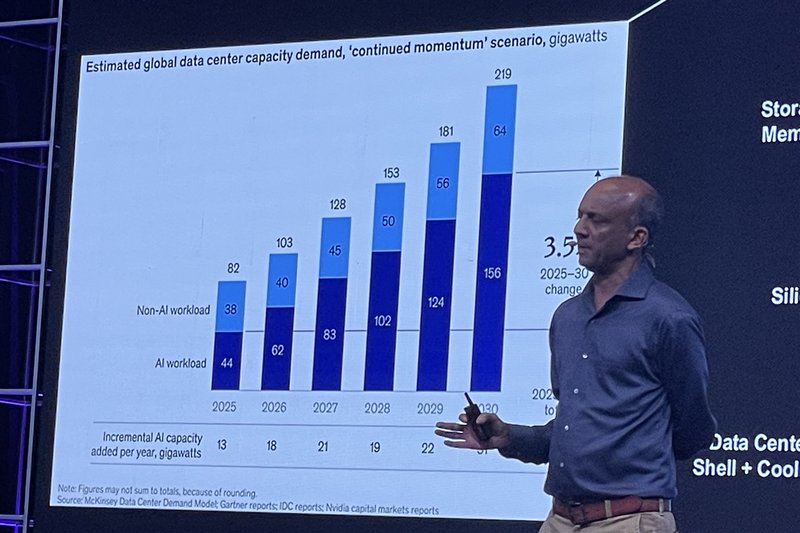
Shenmao, a key player in the technology landscape, has announced record revenue growth, a result directly attributable to the significant boom in artificial intelligence infrastructure. This increase underscores a broader industry trend where the demand for hardware solutions and support services for AI workloads, particularly for Large Language Models (LLMs), is accelerating at an unprecedented pace.
The push towards widespread adoption of generative AI is forcing companies to rethink their IT architectures. The need to process massive volumes of data and perform complex inference requires resilient and high-performance infrastructures, capable of supporting both model training and deployment needs. This scenario creates significant opportunities for technology providers who can offer essential components and services.
The Needs of On-Premise AI Deployments
The AI infrastructure boom is not limited to large cloud platforms. A crucial segment of this growth is represented by the increasing preference for on-premise or hybrid deployments. Many organizations, especially those operating in regulated sectors such as finance or healthcare, prioritize data sovereignty and regulatory compliance. Managing AI infrastructure internally offers greater control over security, privacy, and access to sensitive data, aspects that become critical when working with LLMs.
Choosing a self-hosted deployment involves a careful evaluation of the Total Cost of Ownership (TCO). While the initial investment in hardware, such as high-performance GPUs with high VRAM, can be significant, long-term operational costs and flexibility can often outweigh cloud-based subscription models. Companies are seeking bare metal or containerized solutions that allow for optimized resource utilization and customization of the environment for specific AI pipelines.
Hardware and Architectures for Inference and Training
Modern AI infrastructure requires specific hardware components to manage the complexities of LLMs. Graphics Processing Units (GPUs) are at the heart of this revolution, with high requirements for video memory (VRAM) and computing power. Models like the NVIDIA A100 or H100, with their 80GB or more VRAM configurations, have become de facto standards for training and inference of large models, enabling larger batch sizes and high throughput.
Beyond GPUs, infrastructure efficiency also depends on high-speed networking, performant storage systems, and system architectures optimized for parallelism, such as tensor parallelism or pipeline parallelism. The ability to perform model quantization to reduce memory requirements and improve inference speed is another critical technical factor, allowing LLMs to be deployed even on hardware with more limited resources, further expanding the market for on-premise solutions.
Outlook and Trade-offs in the AI Market
The growth of companies like Shenmao highlights the maturation of the AI market, which is moving beyond the pure experimentation phase to embrace large-scale deployments. Decisions regarding AI infrastructure remain complex, with a constant balance between performance, cost, security, and flexibility. Organizations must carefully evaluate the trade-offs between CapEx investments for on-premise solutions and the OpEx costs associated with cloud services.
For those evaluating different deployment options, particularly for on-premise LLM workloads, it is crucial to analyze specific requirements in terms of data sovereignty, latency, throughput, and TCO. Platforms like AI-RADAR offer analytical frameworks to help decision-makers navigate these complexities, providing tools to compare different architectures and deployment strategies. The future of AI is intrinsically linked to the ability to build resilient infrastructures adaptable to the market's evolving needs.








💬 Comments (0)
🔒 Log in or register to comment on articles.
No comments yet. Be the first to comment!