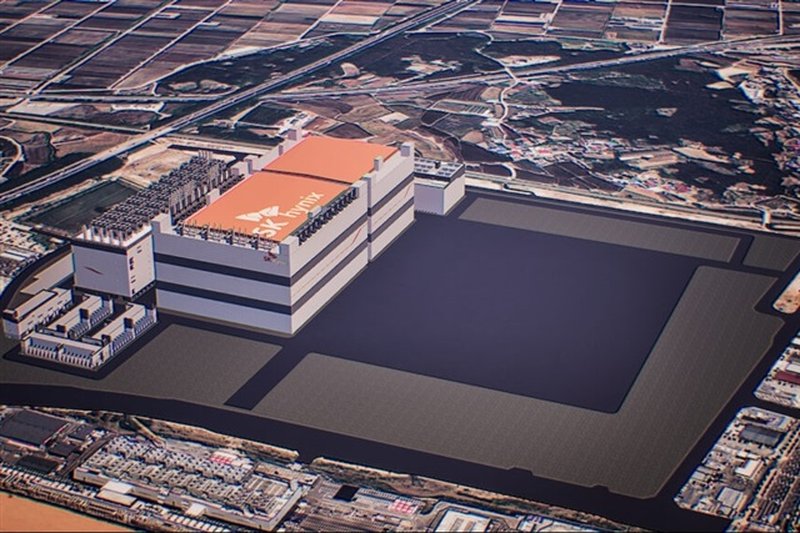
SK hynix’s NASDAQ listing is not just a colossal financial event; it is a near-physical reflection of how hard the artificial intelligence industry is pulling at hardware component supply chains. The $26.5 billion raised – a record for a US IPO – is aimed squarely at aggressively expanding High Bandwidth Memory production capacity, the stacked memory that equips the most powerful GPUs and AI accelerators hungry for bandwidth.
Anyone working with Large Language Models in on-premise environments knows the bottleneck better than most. It is not just raw compute power that limits the size of models you can load onto a single server or a small isolated cluster; it is memory. During fine-tuning, the entire context window, model parameters, and intermediate states must fit in VRAM. With architectures reaching hundreds of billions of parameters, every gigabyte and every gigabyte per second matters. HBM, with its ultra-wide interface and low energy consumption per bit transferred, has become the engineering answer to this problem – but its production is concentrated in very few hands.
SK hynix’s move, therefore, is not merely a market play to challenge Samsung or Micron for share. It signals that HBM demand – largely driven by cloud data centers, but growing among enterprises weighing self-hosted setups for privacy or data sovereignty – is viewed by the manufacturer as structural and long-term. If supply expands, the entire on-premise AI ecosystem could benefit, both in component availability and potentially a gradual easing of Total Cost of Ownership. Today, inference and training hardware eats up the largest slice of local deployment budgets: any relief in high-bandwidth memory pressure translates into more room to maneuver for infrastructure teams.
Of course, the road is not without uncertainties. The production expansion will take years before it translates into cards sitting on system integrator benches or the bare metal ordered by companies. In the meantime, techniques like quantization and CPU-based distributed inference will remain essential levers for those who cannot or will not depend on a cloud subscription. But the news has the merit of making a prospect that seemed distant just months ago more tangible: AI memory supply chains finally more elastic, and less subject to the scarcity cycles that defined the last two years.
For anyone planning an on-premise investment, the timing and scale of the IPO suggest adding the HBM variable to the three-to-five-year Total Cost of Ownership analysis. This is not fantasy economics: it is the difference between being able to load a 70-billion-parameter model on a single machine and having to split it across multiple nodes, with all the consequences for latency, operational complexity, and power consumption.








💬 Comments (0)
🔒 Log in or register to comment on articles.
No comments yet. Be the first to comment!