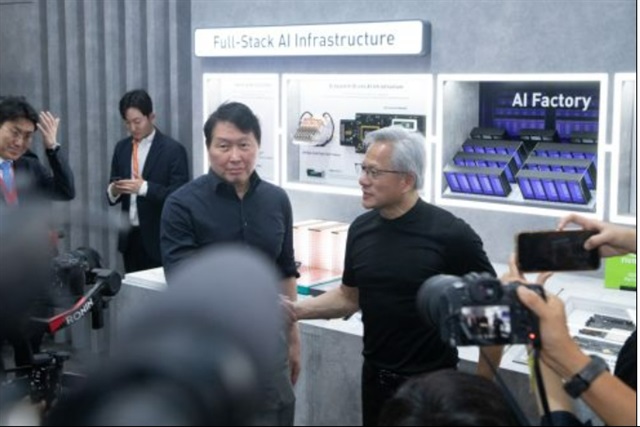
The scene unfolded at SK Hynix's booth at Computex 2026, with two industry heavyweights: Chey Tae-won, SK Group Chairman, and Jensen Huang, Nvidia CEO. The topic wasn't a new chip or a supply agreement, but the possibility of selling memory not as a physical component, but as a service. If realized, it could reshape procurement models across the AI supply chain.
The idea of 'memory as a service' (MaaS) isn't entirely new in IT, but applied to high-bandwidth memory (HBM) — the kind of VRAM that powers GPUs for LLM training and inference — it takes on different contours. Today, AI infrastructure builders, whether in cloud or on-premise, purchase HBM modules along with GPUs or as part of pre-assembled systems. The capital outlay is huge, and memory availability often becomes the bottleneck for workloads with large context windows or fine-tuning of massive models.
Chey's proposal signals a structural paradigm shift: SK Hynix would no longer sell just silicon, but managed memory capacity, with payments based on usage or duration-based contracts. For data centers operating on-premise, this would turn a fixed cost (CapEx) into a variable one (OpEx), while retaining physical control of data. That's a significant advantage in regulated industries where data sovereignty rules out public cloud, but hardware investment rigidity often hampers LLM adoption.
From a market dynamics perspective, MaaS could reduce AI providers' dependency on memory availability cycles, enabling more granular resource scaling. Nvidia, which stood literally beside Chey at Computex, has every interest in exploring models that make its GPUs more accessible to organizations unwilling or unable to lock up millions in VRAM. It looked more like a strategic alliance than a courtesy visit.
On the technical side, questions remain. HBM is tightly integrated with the graphics processor; a consumption-based model would need to match the latency and throughput of fixed hardware and require standardized interfaces for telemetry and billing. There's also the maintenance challenge: who replaces faulty modules, and under what SLA? Questions the enterprise market will inevitably ask.
For those evaluating on-premise LLM deployments, a MaaS offering could introduce an alternative to the binary choice between buying GPUs with soldered HBM and renting cloud instances. A middle ground might emerge: owned servers but with memory consumed as-a-service, upgradeable without replacing the entire node. That would also shift TCO calculations, which today are heavily skewed toward upfront investment.
Chey's proposal is just an idea, but the context in which it was floated — with Nvidia as a high-profile witness — suggests the industry is actively seeking business models that can sustain exponential AI demand without imposing insurmountable capital barriers. If MaaS for HBM materializes, we could see a profound repositioning of the value chain: semiconductor manufacturers would partially become service providers, earning recurring margins and more stable customer relationships. A transformation that started in a small booth in Taipei, but could redefine tomorrow's hardware.






💬 Comments (0)
🔒 Log in or register to comment on articles.
No comments yet. Be the first to comment!