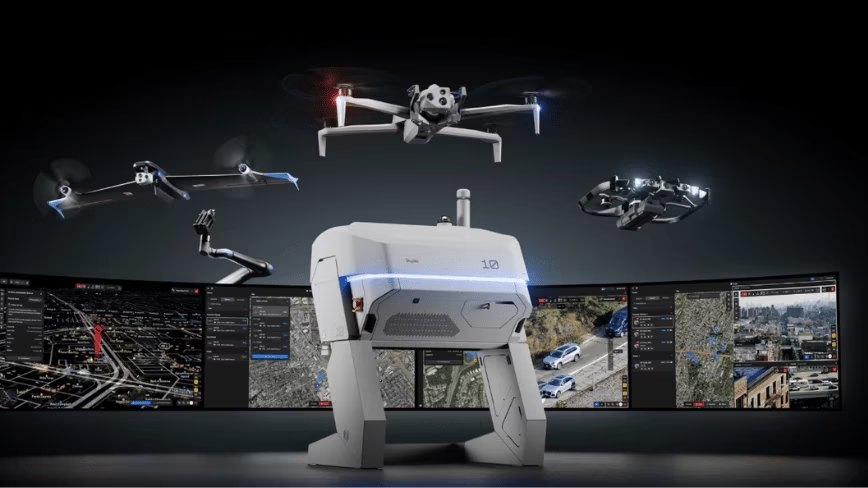
Skydio Bets on Domestic Production: A $3.5 Billion Investment
Skydio, the leading American drone manufacturer, recently announced a far-reaching strategic initiative set to redefine the landscape of drone production in the United States. The company has committed a significant investment of $3.5 billion, to be allocated over the next five years, with the primary goal of drastically expanding its manufacturing capabilities on national soil. This move not only strengthens Skydio's position but also raises broader questions about technological sovereignty and the resilience of production supply chains in strategic sectors.
The announcement comes at a time when discussions about dependence on global supply chains are particularly intense, especially for technologies considered critical. Skydio's decision is situated within a geopolitical and industrial context where many countries are striving to reduce risks associated with interruptions or external controls over essential component supplies.
Expansion Details and Employment Impact
Skydio's investment plan includes the construction of a new manufacturing facility, which will be five times larger than its current plant. This physical expansion is the cornerstone of a strategy aimed at significantly increasing production volume and vertically integrating more phases of the manufacturing process within US borders.
Beyond infrastructure, the initiative will have a notable impact on the job market. Skydio anticipates the creation of over 2,000 direct jobs within the new factory. Approximately 3,000 indirect jobs will be added, generated along the supplier chain. The objective is clear: to build an entirely domestic component supply chain, reducing reliance on foreign sources and ensuring greater control and security over production.
Context and Implications for Technological Sovereignty
While Skydio's announcement focuses on the drone sector, its implications resonate strongly in other critical technological areas, including Large Language Models (LLM) and AI infrastructure. The push for a domestic supply chain for drones reflects a broader trend towards data sovereignty and control over the entire technology stack, a central theme for decision-makers evaluating on-premise LLM deployments.
For companies considering on-premise LLM implementations, the ability to control hardware, software, and, ideally, the origin of components, becomes a crucial factor. This approach ensures not only regulatory compliance and data security but also greater operational resilience and potentially more favorable TCO in the long term, compared to public cloud-based solutions. Dependence on external providers, both for hardware components and cloud services, can introduce vulnerabilities and unpredictable costs, similar to the challenges Skydio aims to address with its strategy.
Future Prospects and Self-Hosted Challenges
Skydio's investment highlights a growing awareness of the risks associated with complex and fragmented global supply chains. The creation of a domestic supply chain for drones represents a model that could be replicated in other high-tech sectors. For organizations moving towards self-hosted AI, this means not only considering the purchase of servers and GPUs but also evaluating the origin and security of every component, from silicio to software frameworks.
The transition to a more controlled and localized model is not without its challenges, including high initial costs and the need for specialized skills to manage bare metal or air-gapped infrastructures. However, the benefits in terms of control, security, and data sovereignty can far outweigh these obstacles, especially for regulated sectors or those with stringent privacy requirements. AI-RADAR offers analytical frameworks on /llm-onpremise to evaluate the trade-offs between on-premise deployment and cloud solutions, providing tools for informed decisions in this evolving landscape.








💬 Comments (0)
🔒 Log in or register to comment on articles.
No comments yet. Be the first to comment!